Why the push works without air
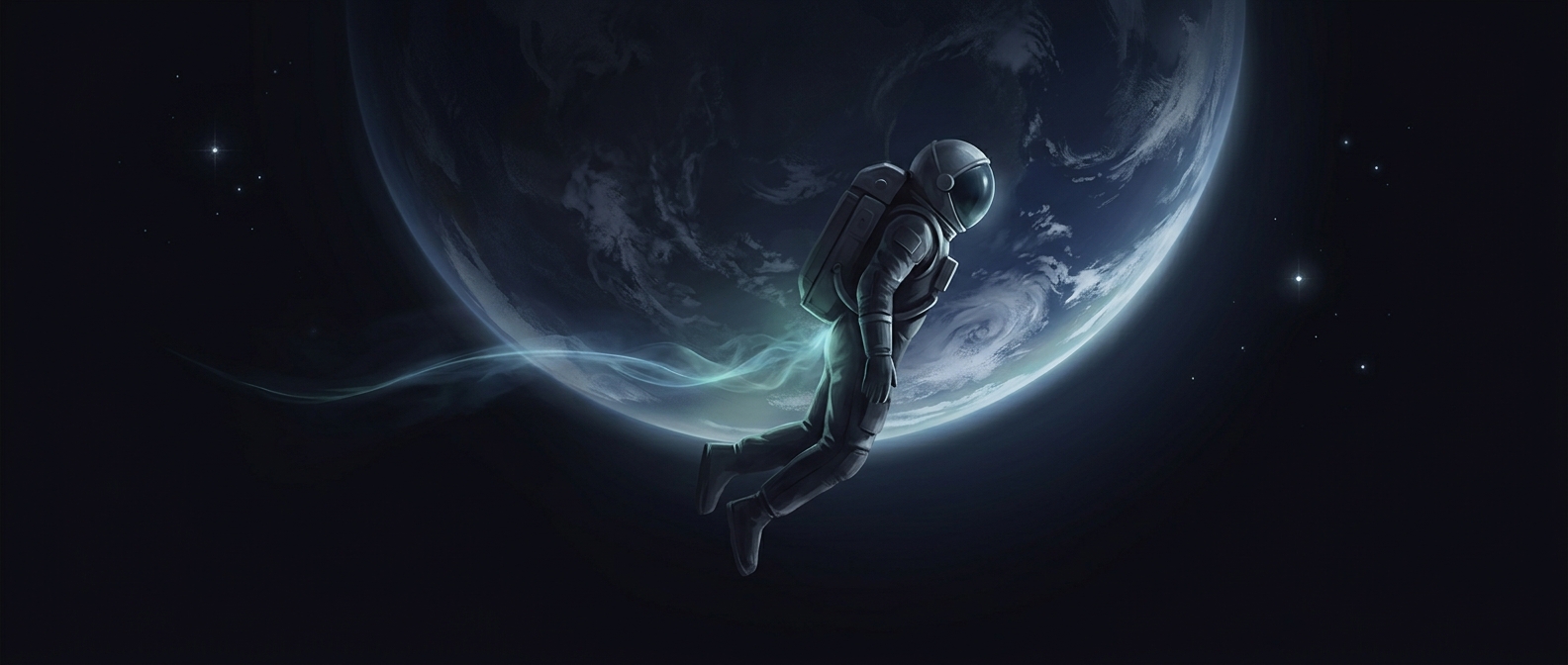
A body does not need something nearby to push against. What matters is the exchange of momentum: as gas is forced out, the gas carries momentum one way and the body recoils the other way. This is conservation of momentum, a rule that applies to the astronaut and the expelled gas together. The same principle lets a rocket accelerate in the vacuum of space; it does not need air to push against.
A nudge, not a steering system
The body’s change in motion depends on how much gas leaves and how fast it is expelled. Since the expelled amount and speed are small, the recoil is tiny. And unlike a spacecraft thruster, the release is not a carefully aimed, repeatable jet. Its direction would determine which way the body moved, so an awkward orientation could make the result less useful—or push the astronaut in an unintended direction.
In space, even a small push can leave an object moving because there is little drag to slow it. But that does not make every push useful: changing course requires a deliberate change in velocity, and controlling that change takes more than producing any recoil at all. The physics is real; the practical lesson is that momentum can be exchanged in the emptiness of space, but a dependable spacecraft needs a controlled source of thrust.