Why a Bubble’s Skin Pulls It Round
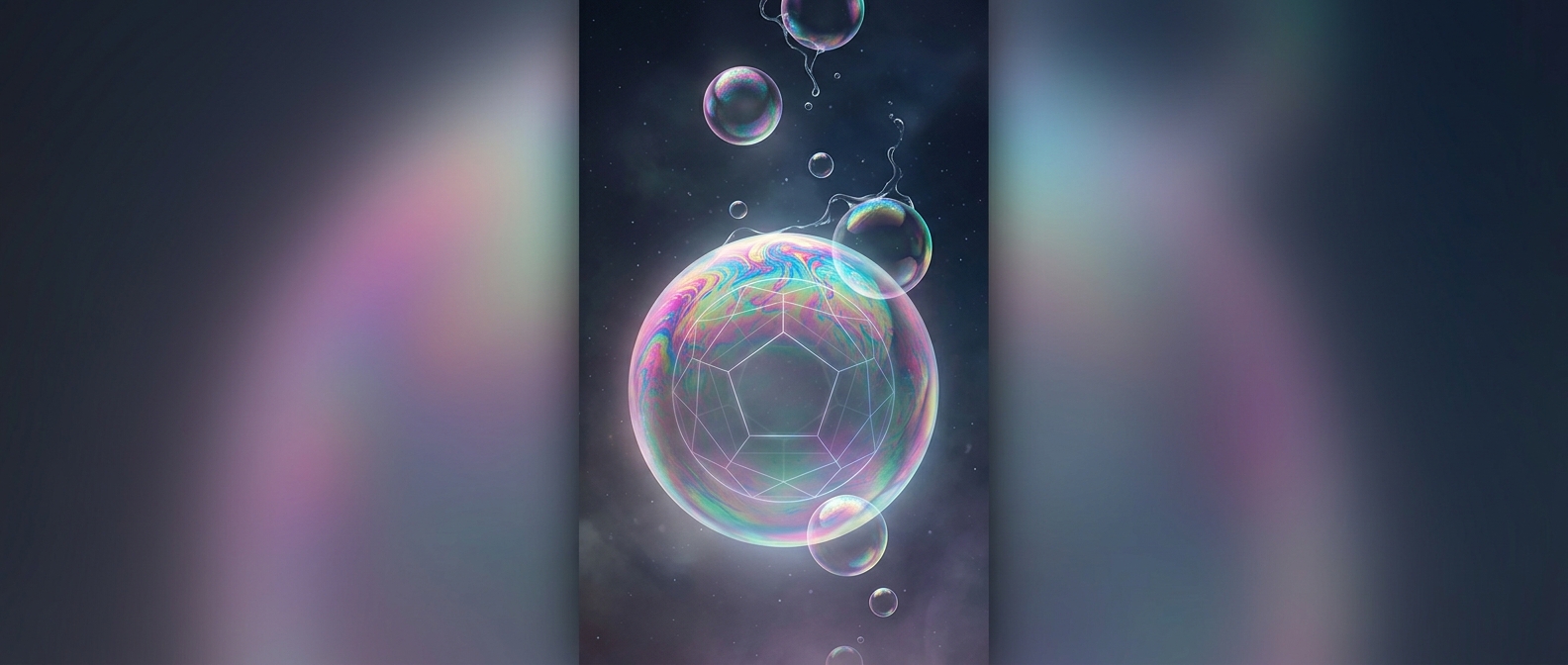
A soap film behaves as if it were stretched like a tiny elastic sheet. Its surface tension—a pull created by molecules at the film’s surface—tries to shrink the area of that sheet. The film cannot simply disappear because it surrounds air, but it can change shape. It settles into a form that encloses that air while using as little surface area as possible.
For a fixed volume of air, a sphere has less surface area than any other shape. That is why a free-floating bubble rounds up: its skin is under tension, and a smaller surface means less film to stretch. The sphere is not chosen by a conscious process; it is the natural result of the film’s pull balancing the pressure of the enclosed air.
Why Bubbles Aren’t Always Perfect
A bubble’s surroundings can disrupt that simple balance. When it touches a wall, another bubble, or a person’s hand, the contact forces it to flatten or form an edge. Air currents and gravity can also distort a large or short-lived bubble. In a cluster, neighboring bubbles press against one another, so their shared boundaries are shaped by the need to fit together—not by each bubble’s wish to be a perfect sphere.
The thin film itself is made of water held between layers of soap molecules. Soap helps the water spread into a stable sheet, while the surface tension keeps that sheet taut. As water drains or evaporates, the film becomes fragile and eventually breaks. Until then, a bubble’s round outline is a visible record of a simple tradeoff: contain the air with the least possible skin.