A rotating blade has a phase
A windmill blade does not occupy a new position at random on every turn. Its motion repeats: after one full rotation, the same blade returns to the same place, moving in the same direction. The blade’s position at any moment in that cycle is its phase—in plain terms, where it is in its repeating schedule.
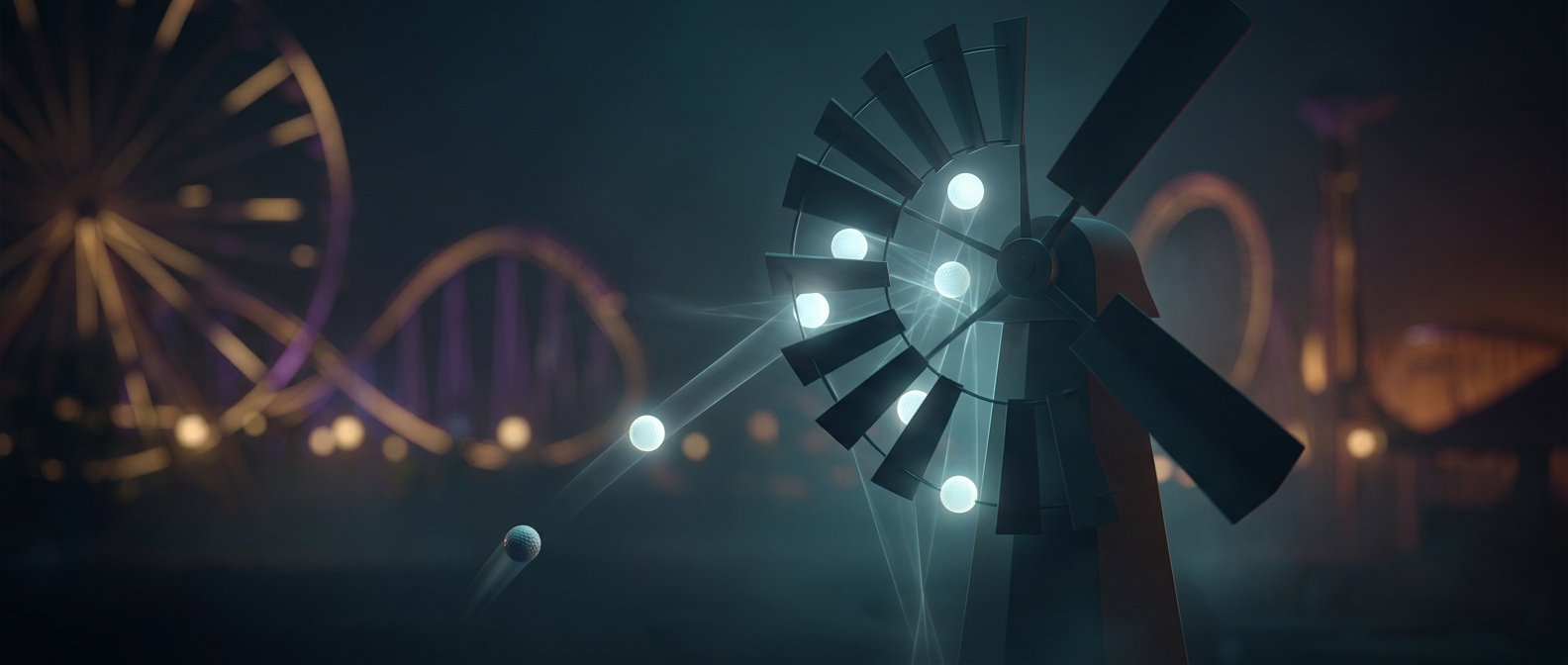
A ball rolling along a fixed path also takes a fairly consistent amount of time to reach the obstacle. Put those two rhythms together and the encounter becomes repeatable. If the ball is released when a particular blade is at a particular point, it is likely to meet the blades at nearly the same phase on another attempt. That can leave the same opening—or the same blockage—in its path.
Why timing can matter more than force
The useful adjustment is often not to hit harder, but to change when the ball starts. A brief pause shifts the blade’s phase at the moment the ball arrives, potentially turning a blocked route into a clear one. This is the same principle used to coordinate with any regularly moving obstacle: predict its cycle, then time the arrival.
The pattern is not a guarantee. A slightly different launch speed, a small change in the ball’s line, or contact with a blade can alter the result. But when the approach is consistent, the windmill is less like a creature choosing when to strike and more like a moving gate with a rhythm. The player’s task is to send the ball through at the right beat.