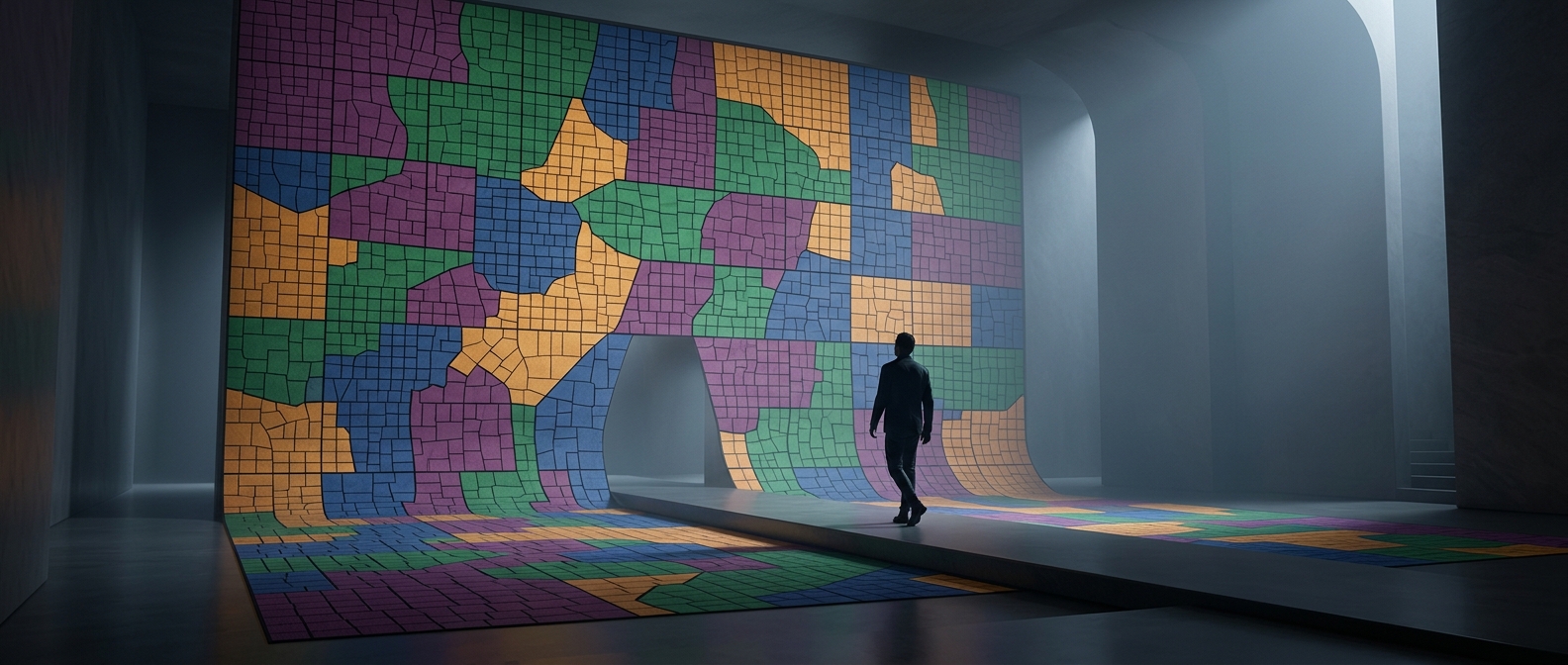
Turn the map into a network
To reason about every possible map, mathematicians first replace its regions with a network. Each region becomes a point, and a line connects two points when the corresponding regions share a border. The map’s coloring problem is now a graph problem: assign colors to the points so connected points have different colors.
Because the regions lie on a flat surface, this network is planar: its lines can be drawn without crossing. That restriction matters. A network with arbitrary connections can demand many colors, but planar networks have a structure that makes four sufficient.
Find patterns that must appear
There are infinitely many possible maps, so checking them one by one could never prove the rule. The proof instead shows that every planar network must contain at least one pattern from a particular finite collection. These patterns are called an unavoidable set: however complicated the network is, it cannot avoid all of them.
A technique called discharging helps establish that such a pattern must exist. It assigns numerical “charge” to parts of the network and redistributes it according to fixed rules. The total charge stays the same, but the rules make it impossible for every local pattern to remain outside the collection. At least one listed pattern must occur.
Check the finite cases
The next step is to show that each pattern in the collection is reducible: if it appears in a map, it can be removed or simplified, the smaller map can be colored with four colors, and that coloring can be extended back across the pattern. In principle, this gives a proof by repeatedly shrinking a map until only a simple case remains.
The challenge was that the unavoidable collection contained too many cases for people to verify reliably by hand. A computer checked the required reducibility cases. The machine did not test every map; it checked a finite list of patterns that the mathematical argument guarantees every map must contain. That is the key leap from an endless family of maps to a proof that can be completed.