Why a sphere needs a cowlick
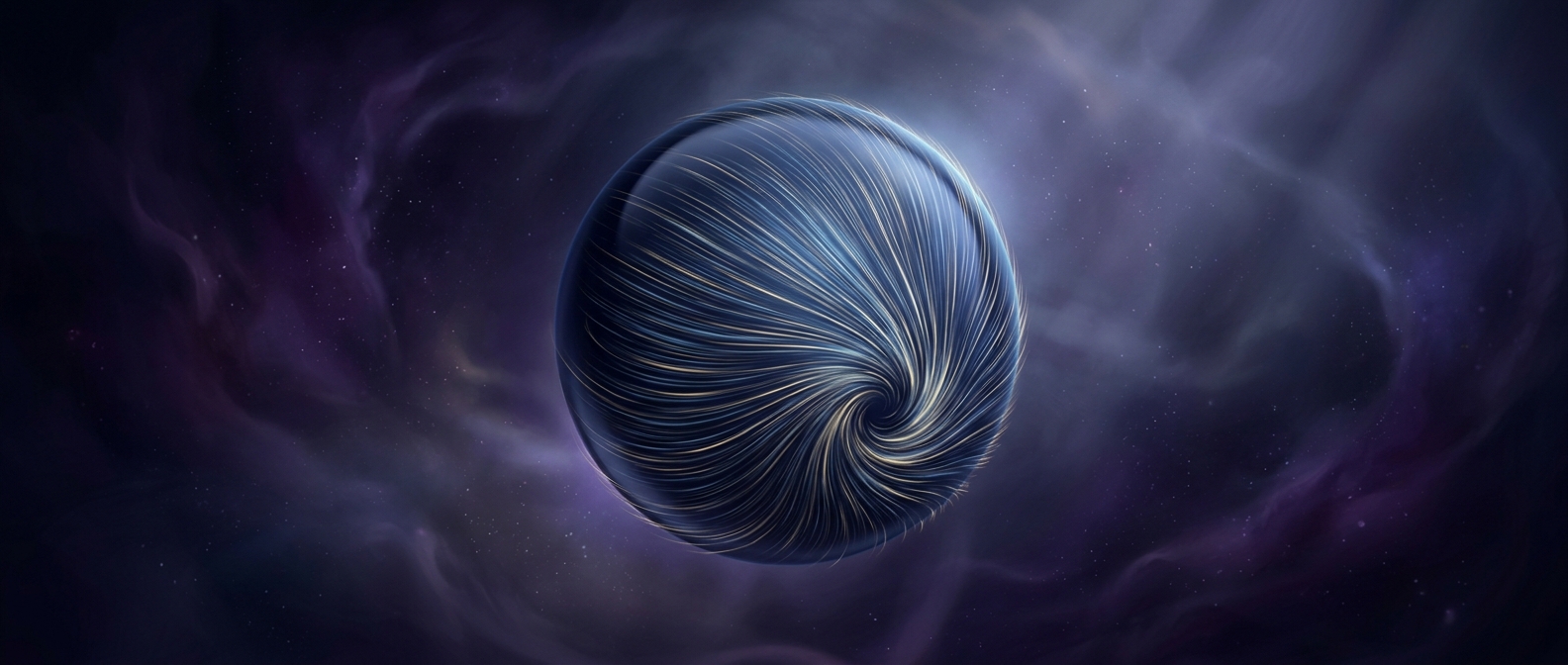
Imagine each hair on a furry ball lying flat against its surface. At every point, the hair has a direction, and neighboring hairs are supposed to change direction smoothly. The hairy ball theorem says that on a sphere, this arrangement cannot stay smooth and nonzero everywhere: at least one point must have no direction at all, or the pattern must become discontinuous.
In mathematics, a direction attached to each point is a vector field. For the theorem, each vector must lie along the sphere’s surface—not point inward or outward—and vary continuously as you move across it. A zero vector is the mathematical version of a cowlick: at that point, there is no preferred direction.
The geometric reason
A flat surface can carry one steady direction everywhere: draw parallel arrows across a sheet. A sphere curves back around on itself, so a direction that looks consistent in one region eventually has to reconcile with the rest of the surface. The theorem proves that no amount of clever combing can avoid a zero somewhere. The trouble is not a bad choice of hairstyle; it is built into the sphere’s geometry.
The result does not say the cowlick must be a single isolated spot. Some patterns can have more than one zero, or a whole set of them. It says only that at least one is unavoidable.
A useful way to picture it
Think of the points on a rotating globe that do not move: the poles. The surface velocity of the rotation gives a direction at each other point, but at the poles that velocity is zero. This is one simple example of the kind of unavoidable zero the theorem describes. The broader lesson is that a smooth, everywhere-nonzero direction field can behave very differently on a sphere than on a plane.