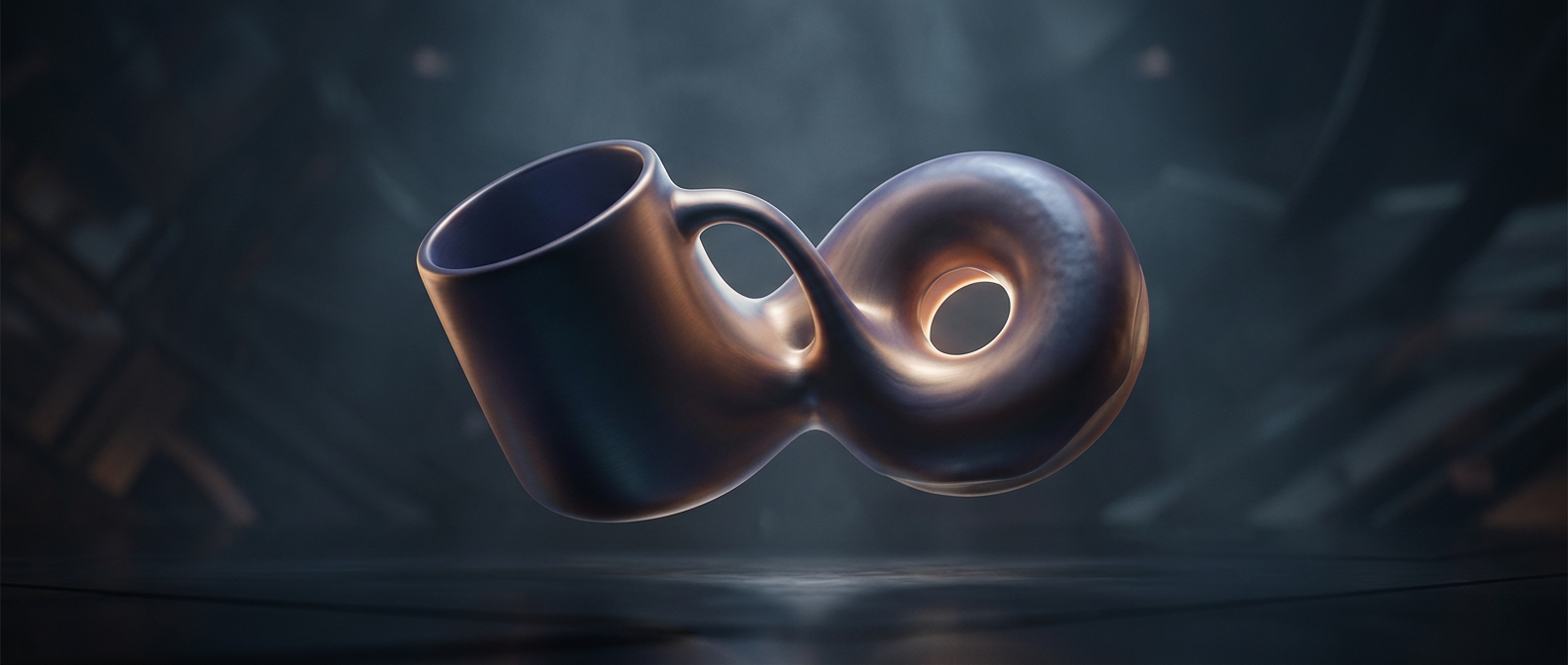
Why a Klein bottle has no separate inside and outside
A Klein bottle is a mathematical surface with no boundary and only one side. On an ordinary bottle, the surface you can touch on the outside is separated from the inside by a wall with two distinct faces. A Klein bottle does not have that division: if you trace its surface continuously, you can return to your starting point having reached what would have been the other side, without crossing an edge.
The key is that “inside” and “outside” are not built into every surface. They depend on whether the surface can be consistently assigned two sides. A familiar example is a Möbius strip: give a paper strip a half-twist and join its ends, and a line drawn along one face can travel around the strip and reach what looked like the opposite face. A Klein bottle extends this one-sided idea into a closed surface, with no edge at all.
Why the glass model appears to puncture itself
To picture the bottle, diagrams and glass sculptures often show a long neck bending around and passing through the body before joining its base. That apparent crossing is a compromise imposed by ordinary three-dimensional space. At the crossing, the pictured surface must pass through itself, which a real, thin sheet cannot do without intersecting.
Mathematically, the surface can be made without that self-intersection in four dimensions. The extra dimension provides room for the neck to pass around the body rather than through it. A three-dimensional model projects that route into our space, where the paths appear to collide. The collision belongs to the representation, not to the ideal surface.
What the model is—and is not—showing
A glass Klein bottle is therefore useful as a guide to the surface’s shape, but it is not a literal, nonintersecting Klein bottle. Its neck seems to enter the body because the model compresses a four-dimensional arrangement into three dimensions. The memorable twist is that the bottle’s “inside” is not hidden behind its wall: on the abstract surface, there is no separate inside to reach.