How a parked airliner makes its own power
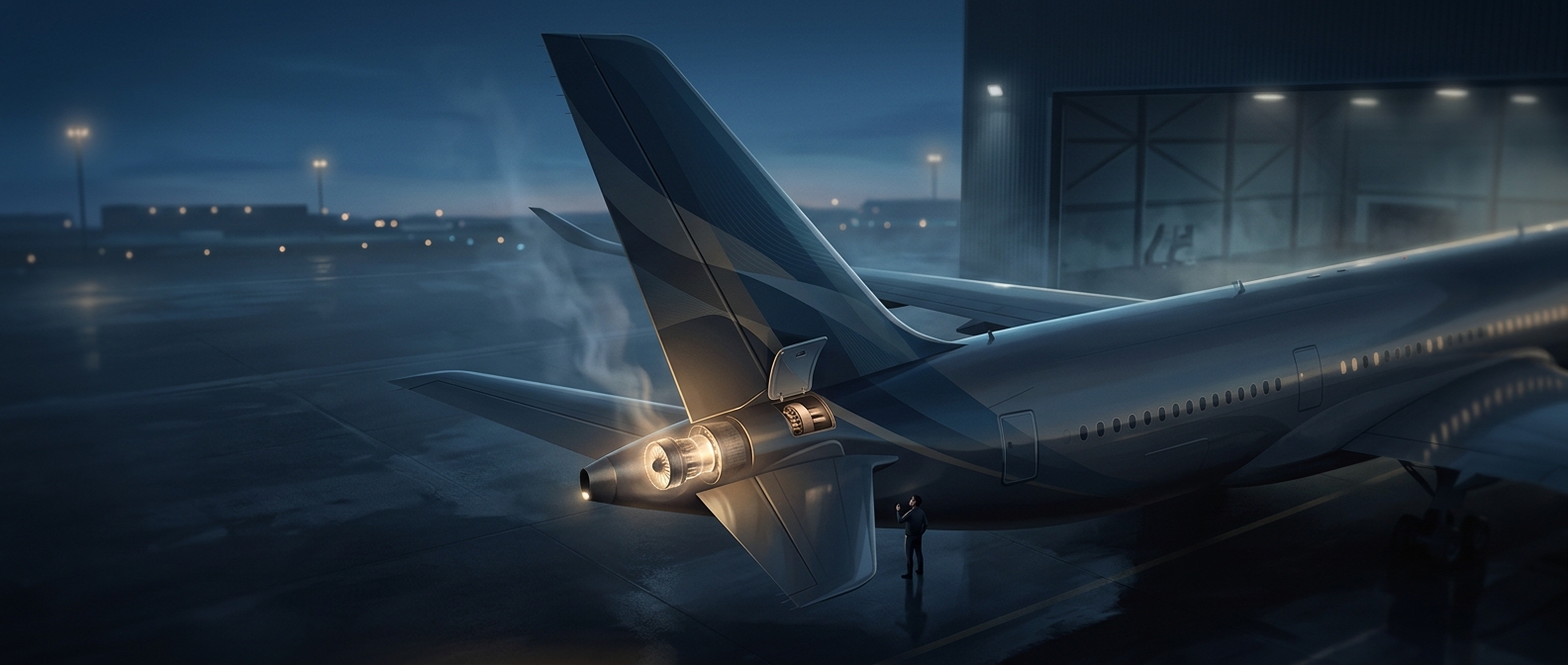
A jet at the gate still needs electricity for cockpit displays, cabin lights, pumps, and other systems. It may also need air to run the cabin’s ventilation and air-conditioning. Rather than keep a main engine running for those jobs, many airliners use an auxiliary power unit, or APU: a compact turbine engine built into the aircraft, usually near the tail.
The APU burns fuel to spin a shaft. That shaft drives a generator, producing electricity. The turbine’s hot exhaust is not normally sent into the cabin; instead, air drawn through the unit is compressed and routed through aircraft systems. In the usual setup, that compressed air helps power the air-conditioning packs and, during engine start, turns the main engine’s starter system.
From gate power to engine start
When available, a gate can supply electricity and conditioned air through ground equipment, reducing the need to run the APU. But the aircraft may need its own source when ground equipment is unavailable, or when it is preparing to leave. The crew starts the APU, checks that it is supplying the required power and air, and then uses it to start the main engines.
Once the main engines are running, they can provide the aircraft’s electrical power and compressed air, so the APU can usually be shut down. It is a handoff between power sources: the small turbine supports the airplane while parked and during startup; the larger engines take over for flight.
That arrangement avoids using a much larger engine merely to keep the cabin and cockpit functioning at the gate. The APU is small by comparison, but it performs a pivotal job: it lets a jet prepare to depart without first making its main engines roar.