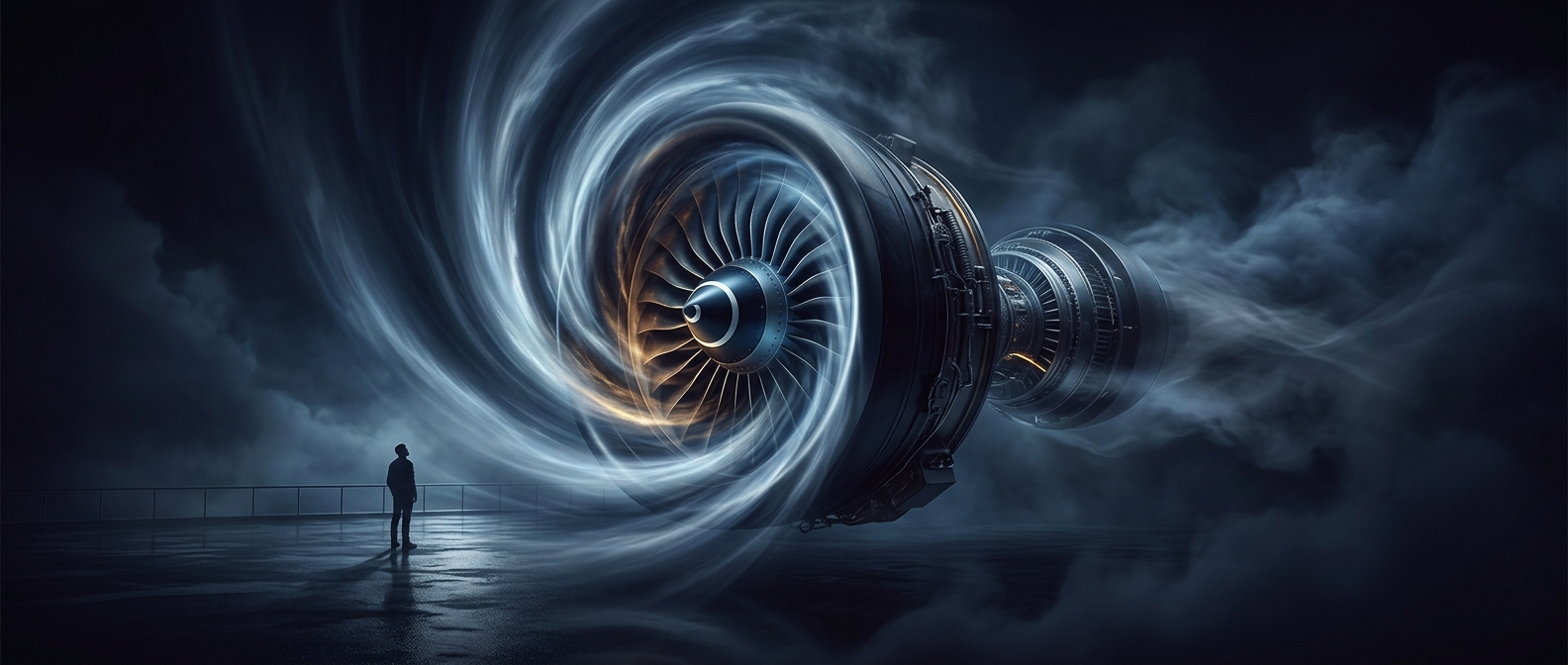
Why a Jet Engine Needs Such a Large Airflow
An engine’s thrust comes from changing the motion of air: it takes in air moving relatively slowly and sends it backward faster. The resulting forward push is the reaction to that rearward acceleration. Moving a vast mass of air by a modest amount can produce substantial thrust, which is why an engine’s appetite for air dwarfs its fuel consumption.
In a modern turbofan, the large fan at the front handles much of that airflow. Some air enters the engine’s core, where compressors squeeze it before fuel is burned. The hot gas then spins a turbine, which is connected by a shaft to the compressors and fan. The remaining air flows around the core through a separate passage called the bypass duct. The fan speeds up both streams, while the core’s hot exhaust adds thrust as well.
The Airflow Shapes the Engine
This arrangement is a practical tradeoff. Pushing a large volume of air backward gently is generally an efficient way to produce the steady thrust needed by an airliner. The fan and bypass duct therefore make a turbofan look less like a narrow tube for hot exhaust and more like a powerful air mover with a compact gas-turbine engine at its center.
Fuel still matters: burning it supplies the energy that keeps the turbine turning. But the engine’s job is not simply to make a hot blast. It uses that energy to keep an enormous stream of air moving rearward—and the forward push on the aircraft follows from that motion.