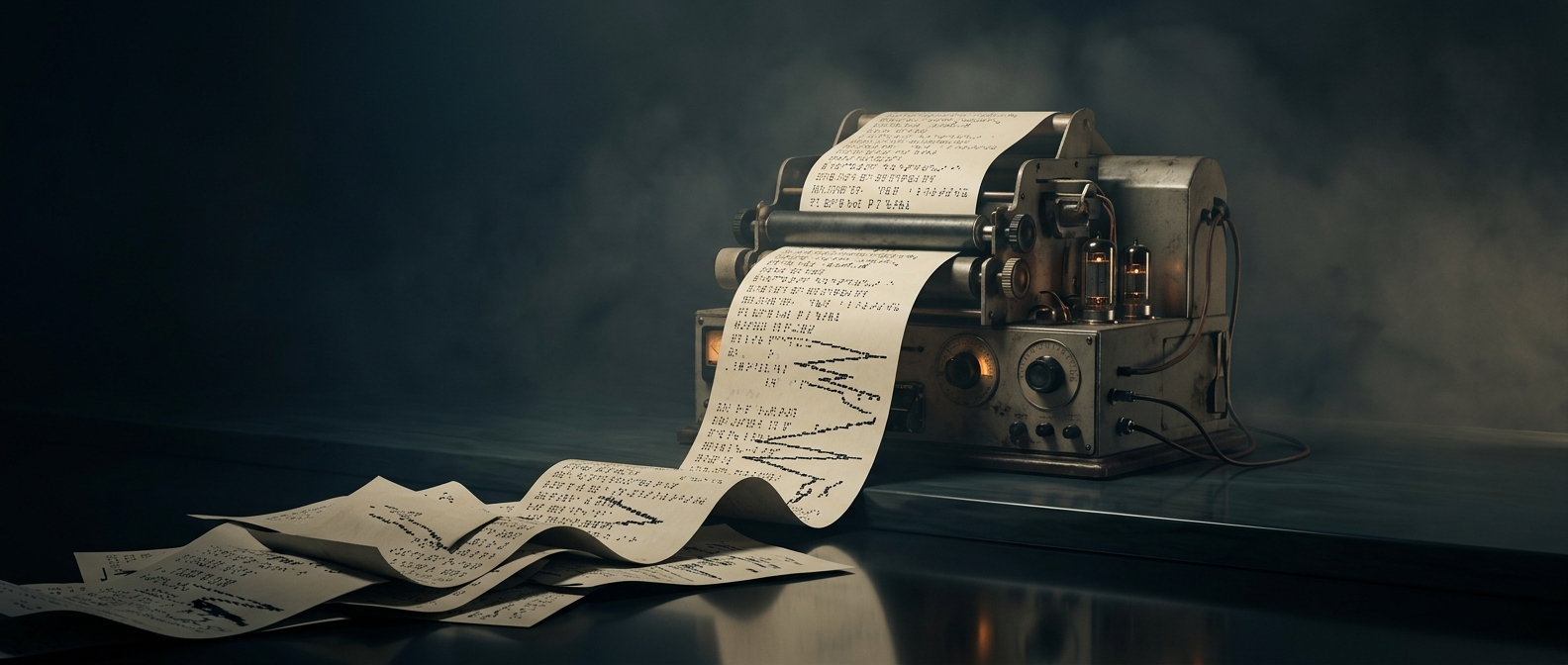
Sending letters as pictures
A conventional teleprinter sends a code for each character. The receiver must recognize that code correctly before it can print the letter; if interference changes a crucial part, one character can become another or disappear. Hellschreiber took a different route: it represented each letter as a small pattern of marks and spaces, then sent that pattern one piece at a time as changes in an audio signal.
At the receiving end, the signal controlled a printer that placed marks in corresponding positions on a moving strip of paper. The result was not a decoded stream of letter codes but a line of roughly drawn characters—more like a picture assembled from dots.
Why rough marks could still get through
Static could still hide a mark or create a stray one. The advantage was that damage to a few dots did not necessarily destroy the whole letter. A reader could often recognize the remaining shape from its overall pattern, much as a word can be understood when one letter is smudged. That made the system useful on radio links where a clean signal could not be counted on.
The tradeoff was that Hellschreiber spent time transmitting the visible structure of each character rather than sending a compact character code. Its output could look uneven, but it gave the receiver—and ultimately the human reader—more than a brittle all-or-nothing symbol to work with. A little static might roughen the printed letter without making the message unreadable.