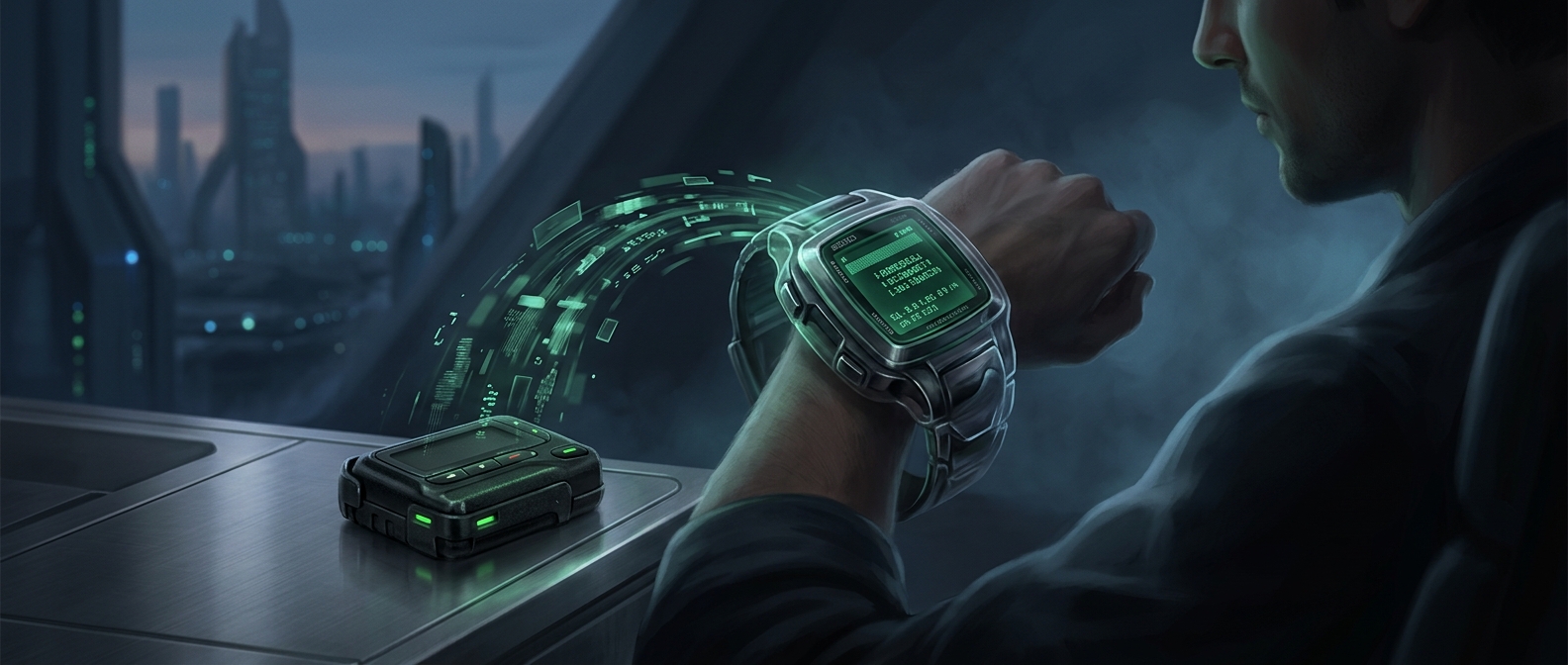
A wrist computer built around a tiny control
The Ruputer’s defining challenge was not simply shrinking a computer; it was making one usable on a wrist. Its small joystick offered a way to move through menus without a keyboard or touchscreen. That made the device navigable, but every task had to fit the limits of a little display and a control operated with a fingertip.
This favored brief, structured interactions—choosing an item from a menu, for instance—over the open-ended work people do on a desktop. The Ruputer was best understood as a compact personal computer with a watch form, not as a miniature version of a modern phone.
The computer on the wrist, the PC at the desk
The docking station connected the Ruputer to a personal computer, giving it a practical bridge to a larger screen and more comfortable controls. Instead of treating the wrist device as a self-contained workstation, its design paired portable access with desktop support: the user could handle information on the watch, while the PC made exchanging or managing that information easier.
That arrangement reveals the engineering tradeoff behind early wearable computers. Shrinking hardware made computing portable, but it also shrank the interface. A joystick and dock were not incidental accessories; they were ways to make that constrained interface workable. The Ruputer’s lasting significance is in that design experiment: it brought a computer onto the wrist years before touchscreens became the expected way to control one.