Why a wine press could print a page
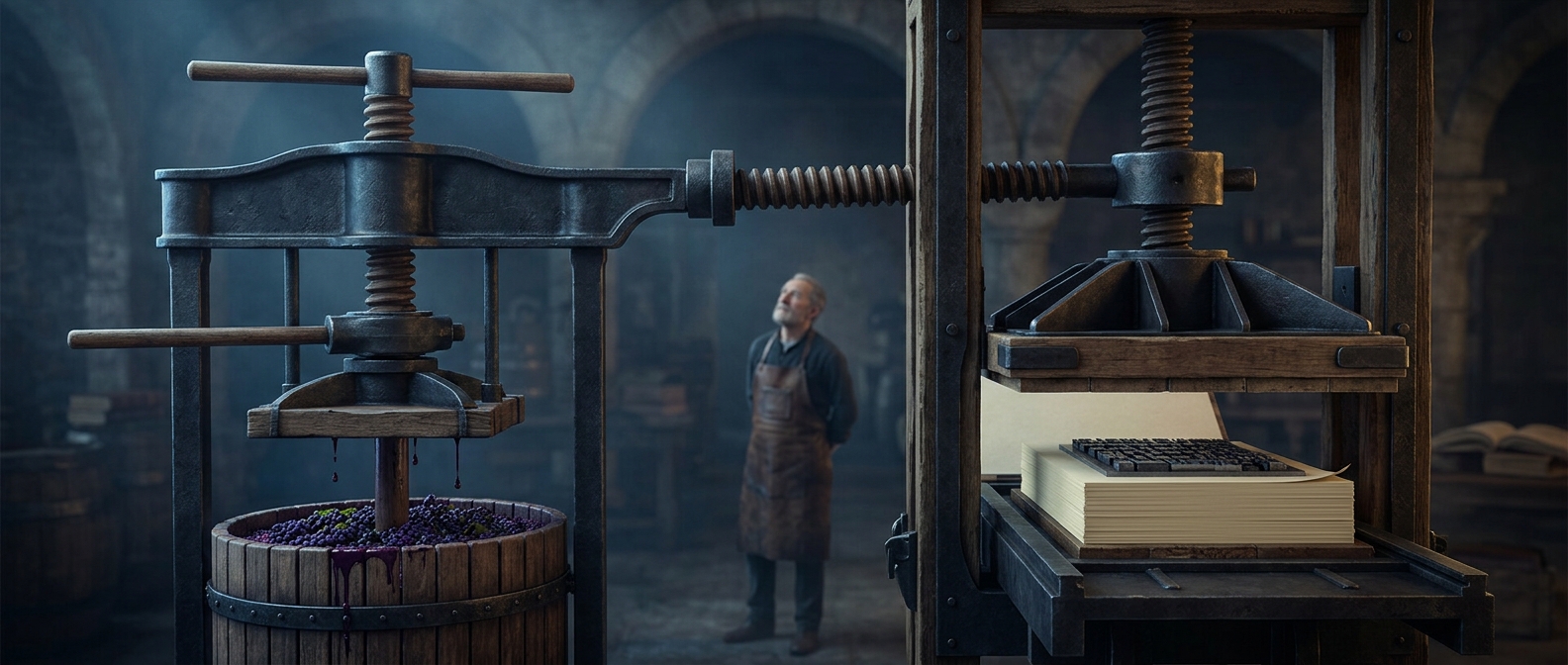
A screw press solves a simple mechanical problem: it turns a slow twist into strong, controlled downward force. In a grape press, that force squeezes fruit. In Gutenberg’s adaptation, it brought a broad, flat platen—the press’s pressing plate—down onto paper laid over inked type.
The important change was not just what the press squeezed, but how precisely it did so. Letters cast as separate pieces of metal could be arranged into lines and locked together in a frame. The platen then pressed the sheet against that fixed arrangement, transferring the inked faces of the letters to the paper.
From crushing to repeatable impressions
A useful press had to do more than make contact. Pressure needed to reach the type evenly across the page: too little in one area could leave faint letters, while uneven force could produce a blotchy impression. The screw let a printer apply substantial pressure in a controlled motion, then raise the platen to remove the sheet and prepare for another impression.
That cycle made the press suited to repeated work. Once a page of type was set, printers could use the same arrangement to produce multiple copies before taking it apart and setting new text. Each sheet still had to be handled and inked, but the machine replaced the slow, separate act of copying every letter by hand.
A familiar machine, a new kind of work
The adaptation joined two pieces of a printing process: movable type made words rearrangeable, and the press made those words reproducible on paper. The old press’s basic advantage—turning a screw to apply force—remained intact. What changed was the object beneath the platen and the purpose of the pressure.
That is the striking engineering leap: a machine designed to extract juice could also make language repeatable, one evenly pressed sheet at a time.