How spinning disks turned motion into a spark
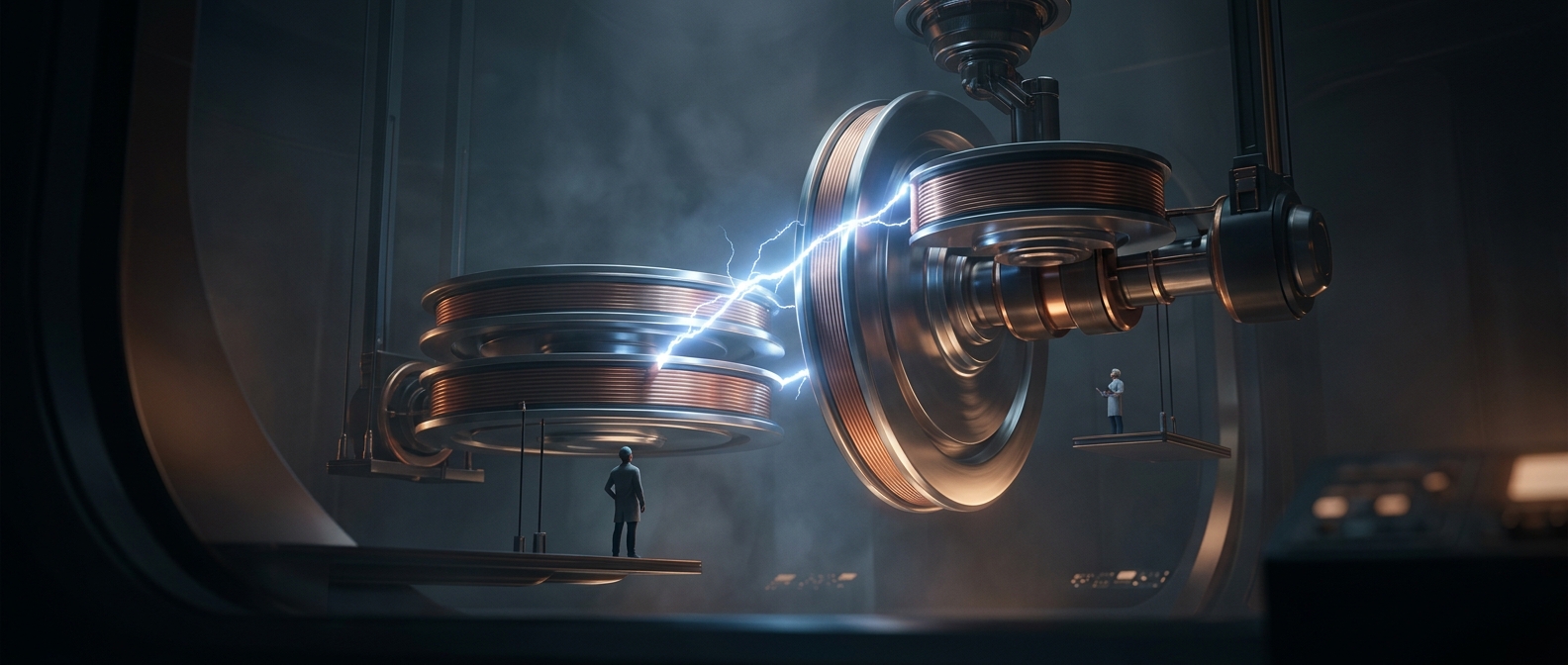
In a Victorian influence machine, turning the disks did more than rub materials together. Small metal sectors fixed around each disk passed near sectors on the other disk. Their electric fields nudged charge around: a nearby charged sector could encourage an opposite charge to gather on a passing sector, while leaving charge of the other kind elsewhere. This process, called electrostatic induction, let the machine build up separated charges without needing a battery.
The disks’ opposite rotation kept the sectors moving through this pattern of influence. Metal combs positioned near the disks then collected charge from the sectors and carried it to separate terminals. A hand crank supplied the energy; the machine converted that mechanical work into an increasingly strong difference in electrical charge between its terminals.
Why the jars made the discharge dramatic
A Leyden jar was an early capacitor: a device that stores separated electric charge. It typically used a glass jar with conductive material on the inside and outside. The glass kept those charges apart while allowing their electrical influence to act across it. Connecting the machine’s terminals to the jars let charge accumulate on the two conductive surfaces.
As the separation grew, the electric field in the gap between the machine’s terminals grew stronger. Eventually it could overcome the insulating effect of the air, making the air briefly conductive. Charge rushed across that path as a spark, and the jars discharged. The sudden flash was therefore not a continuous supply of electricity but stored charge released in a short burst—a visible payoff for every turn of the crank.