How a cathode-ray tube became computer memory
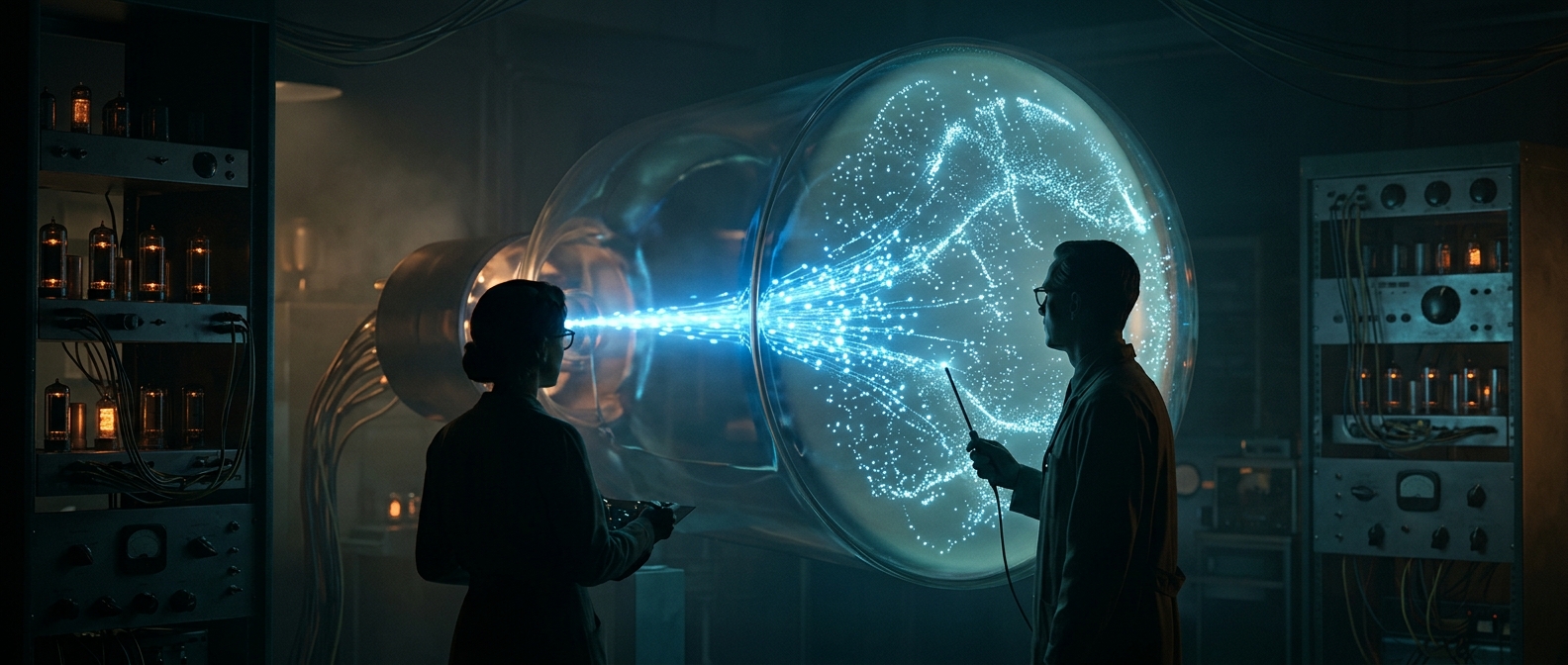
A Williams tube repurposed the kind of display tube used in early televisions. Inside, a focused beam of electrons swept across a coated glass surface. When the beam struck a tiny spot, it knocked loose some electrons—a process called secondary emission—leaving that spot electrically charged. The pattern of charged and uncharged spots represented bits of data.
The information was not stored as visible writing. It existed as an electrical pattern on the screen’s surface, so the tube could hold data without mechanical parts moving through it.
Reading meant scanning the screen again
To retrieve a bit, the computer directed the beam back to the spot. The charge there affected the electrical signal detected by a nearby pickup plate, allowing the circuitry to distinguish the stored state. By scanning spots in sequence, the machine could recover a whole row of bits.
Reading was not entirely passive: revisiting a spot disturbed its charge pattern. The computer therefore had to write the data back after reading it. The charge also gradually leaked away, so the system repeatedly refreshed the pattern—much like later memory technologies that must continually restore fading information.
A fast memory with a visible weakness
The tube gave early computers a way to keep working data electronically, but its operation depended on carefully controlling an electron beam and preserving delicate charges on a surface. Temperature changes, electrical noise, or imperfect beam alignment could make stored bits unreliable. Engineers had to build circuitry that not only read and rewrote data but also kept the pattern stable enough to use.
That tradeoff made the Williams tube a striking bridge between display technology and computer memory: the same beam that could draw a spot on glass could also write a bit, and the computer had to keep redrawing the pattern before it faded.