A promenade held above the waves
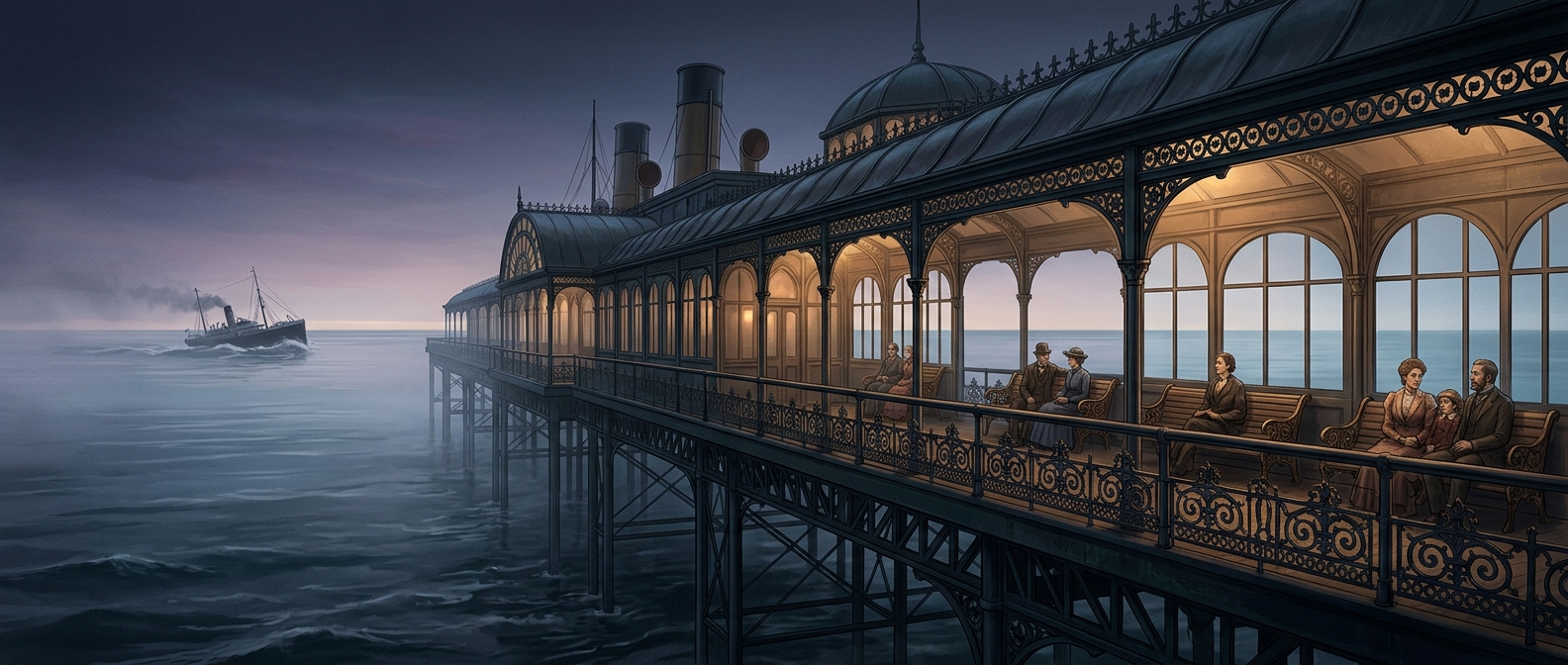
A pleasure pier offered the sea as scenery without making visitors travel on it. Unlike a boat, a pier was fixed to the seabed, so it did not rise and roll with each swell. The structure could still tremble in rough weather, but its deck gave people a steadier place to walk, pause, and look out over open water.
That difference mattered to seaside visitors who wanted the breeze and views but disliked the queasy motion of a vessel. A pier also let them move beyond the beach: at high tide, when the shore might be narrow or covered, its long deck remained accessible above the water.
How engineers made the walk possible
The challenge was to support a long public walkway without building a solid wall across the sea. Victorian engineers used rows of narrow supports, leaving water and waves room to pass between them. Eugenius Birch helped advance this approach in Britain, using iron construction and screw-pile foundations—metal supports twisted into the seabed—to carry piers over open water.
Those supports made the pier an engineering structure as well as a promenade. It had to withstand wind, salt, waves, and the repeated movement of crowds, while remaining open enough not to act like a barrier to the sea.
The seaside, extended
Once people could stroll safely out over the water, the pier became a destination in its own right. Visitors could linger over the view rather than simply bathe or walk along the beach, and resorts gained a public attraction that drew people toward the shoreline.
The ingenious part was not that a pier removed the sea’s motion, but that it separated the visitor from it: the waves remained in view and underfoot, while the promenade stayed anchored above them.