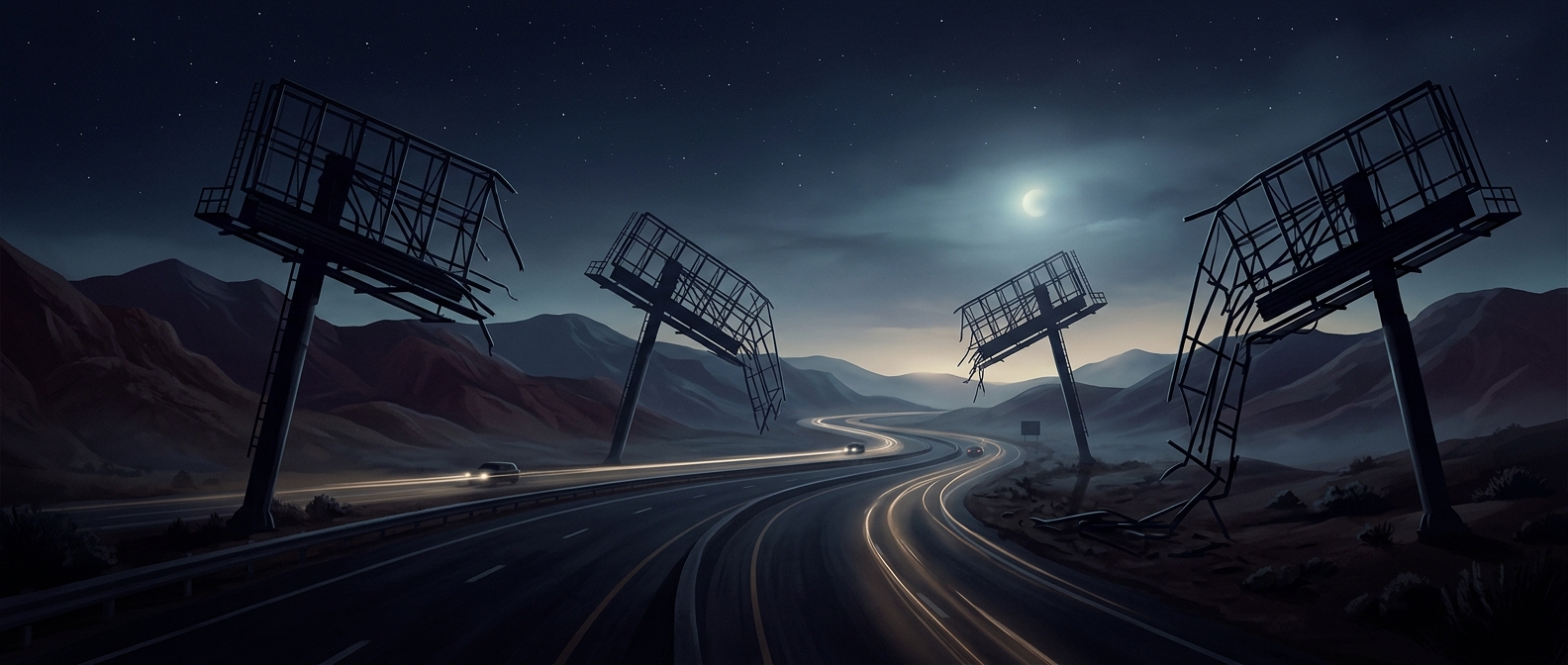
What a highway billboard ban actually removes
A billboard ban does not mean a road has no signs. Drivers still encounter traffic directions, warnings, and signs identifying businesses on their own property. The target is off-premise advertising: a large sign promoting something located somewhere else, placed where passing motorists will see it.
That distinction matters. A state can keep road information and local business identification while preventing highway corridors from becoming rows of advertisements. The rules typically govern where signs may be built and what they may display, rather than requiring every roadside marker to disappear.
The view is shaped by what can be built
Billboards are powerful because highways deliver a steady stream of viewers who have limited alternatives to looking at the roadside. A single sign can reach thousands of travelers, but repeated signs compete with the landscape and can make a scenic route feel like an advertising corridor. Blocking new off-premise structures changes the view before a driver reaches it: there is no succession of commercial messages to interrupt the hills, coast, or forest.
The policy also creates a tradeoff. Businesses lose a highly visible way to reach travelers, while communities gain more control over the appearance of roads that residents and visitors share. Local signs can still help drivers find nearby services, but they do not offer the same broad reach as a billboard aimed at through-traffic.
A state-level choice with lasting effects
Alaska, Hawaii, Maine, and Vermont are commonly identified as the four states with statewide billboard bans. Their approaches reflect a decision to treat roadside scenery as something worth protecting from large, off-site advertising—not merely as empty space available for sale.
Because the restriction concerns structures and placement, it can shape a corridor for years: once a billboard is not allowed to go up, the landscape remains visible without requiring drivers to look past another commercial message.