The message became a pattern of electrical pulses
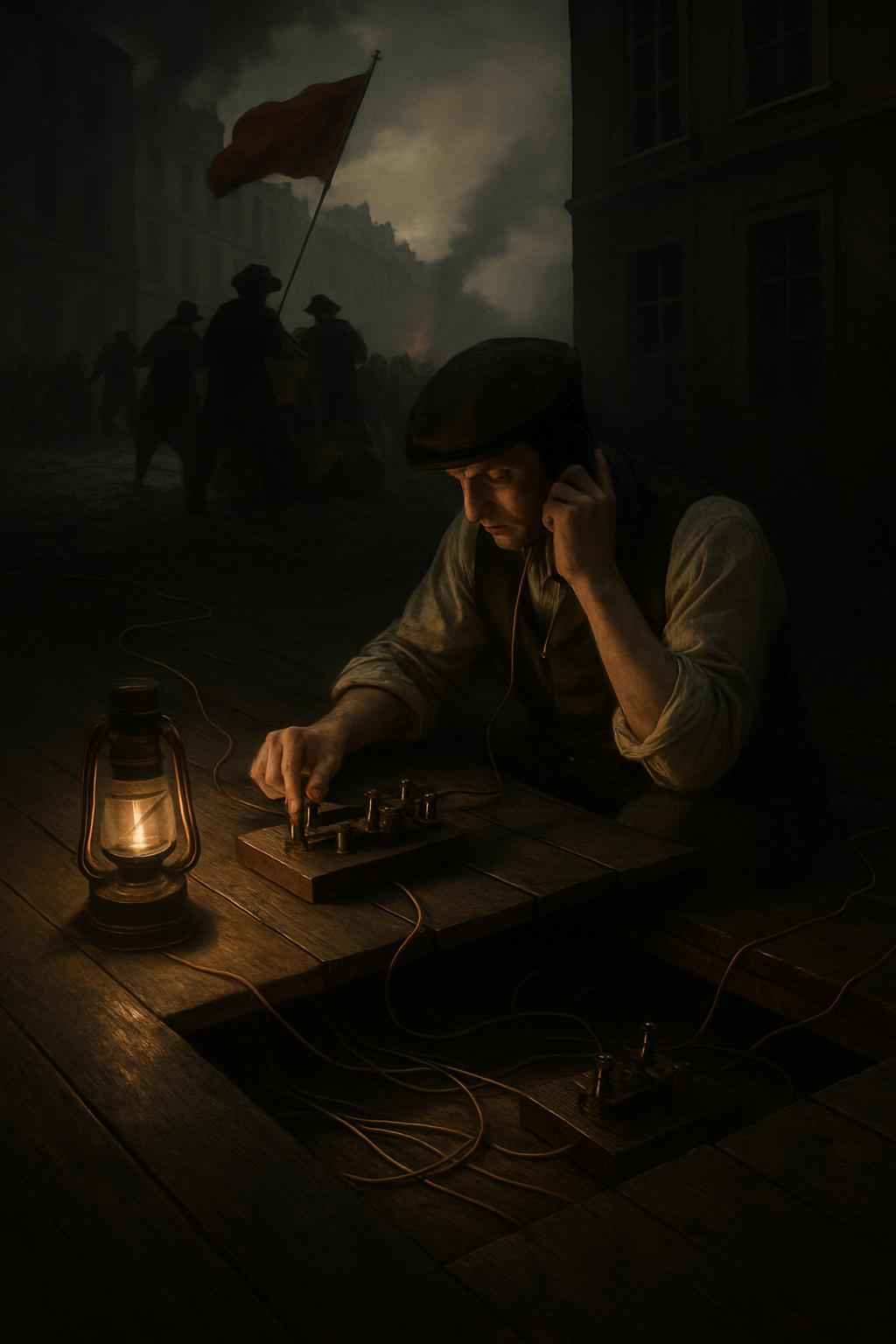
At each end of the Washington–Baltimore line, an operator worked a key that opened and closed an electrical circuit. Those changes traveled through the wire as pulses. Using Morse code—a system that represents letters with combinations of short and long signals—the receiving operator turned the pulses back into words.
The wire did not carry a spoken voice or a written page. It carried a pattern that a trained person could interpret. That distinction made the system practical over distance: a brief signal could cross the line far faster than a person or vehicle could carry a note.
The wire was only part of the system
A long-distance telegraph needed more than a transmitter and receiver. The route had to be built, maintained, and connected to staffed offices where people could send and collect messages. Operators translated ordinary language into code, checked incoming signals, and passed the result along to its recipient.
That made telegraphy a network service rather than a private conversation between two homes. Its speed changed what people could coordinate: businesses could relay orders, newspapers could receive distant reports, and officials could exchange urgent information without waiting for a courier to arrive.
Speed changed the value of distance
Before the telegraph, information usually moved with the person carrying it. A message could not outrun a horse, a ship, or the condition of the road. The new line separated information from its carrier: once a route existed, a short report could arrive while the event was still unfolding.
The limitation was equally concrete. The telegraph could move a message quickly only between connected points, and a human operator still had to encode, interpret, and deliver it. Its lasting breakthrough was not instant communication everywhere, but the first workable model for sending information faster than the people who needed it could travel.