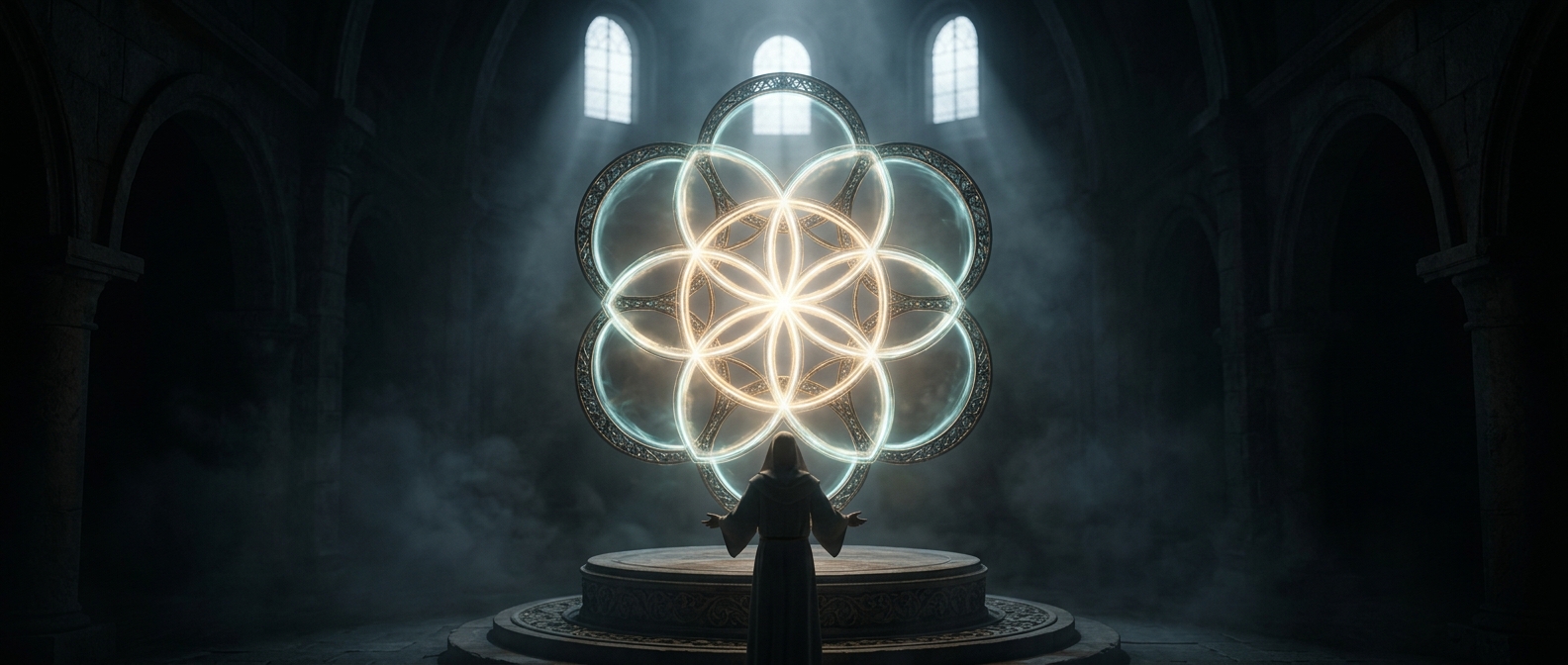
How 13 circles become the Fruit of Life
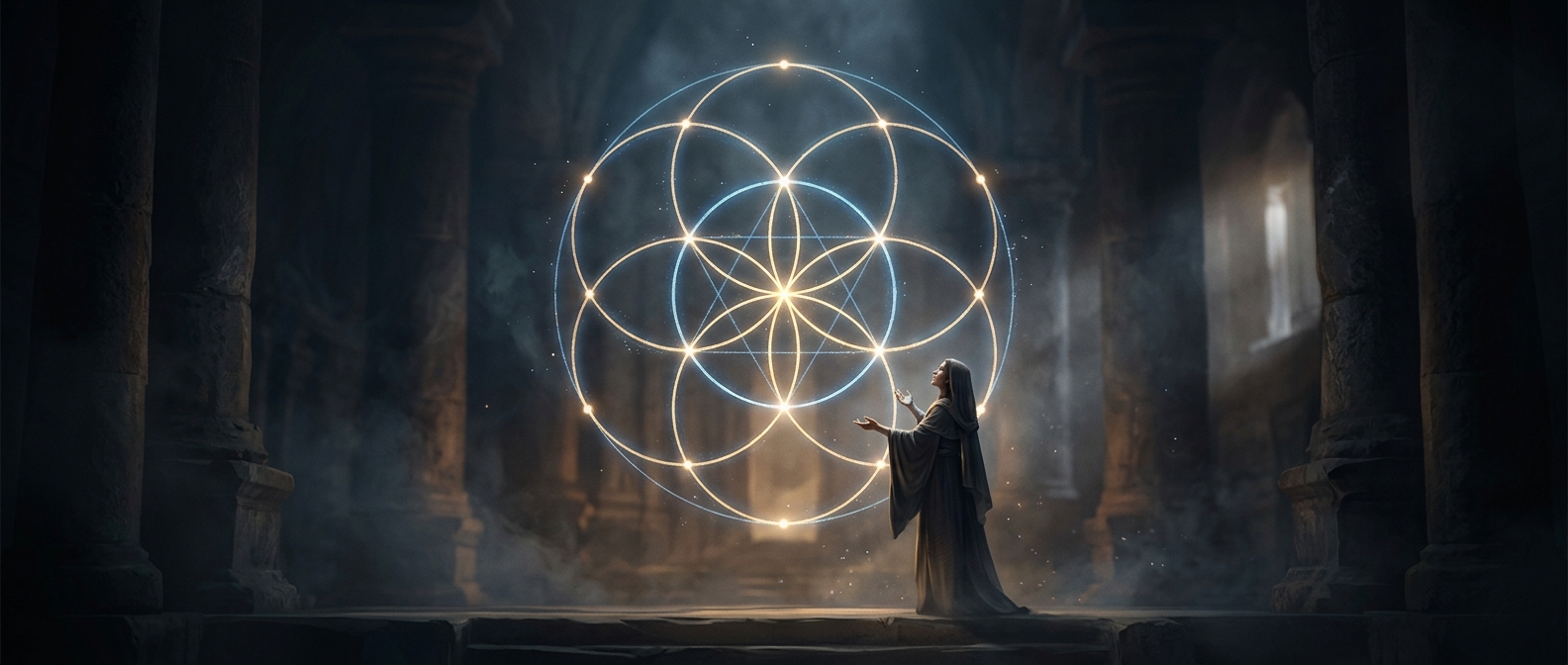
The Fruit of Life is a pattern made from 13 equal, overlapping circles. In a common construction, one circle sits at the center, six surround it, and six more complete the larger arrangement. Because neighboring circles share carefully spaced centers, their arcs cross in a repeating network of points and curved shapes.
That network is what makes the pattern feel more intricate than a cluster of circles. Straight lines can be drawn between selected intersections, and additional shapes can be traced inside the resulting grid. Sacred-geometry traditions associate those constructions with forms such as the Metatron’s Cube and with ideas about the structure of creation. The drawn geometry is real; its status as a hidden blueprint for nature is a matter of spiritual interpretation, not a mathematical finding.
Why the pattern is treated as a framework
The circles provide a compact set of repeated relationships: each has the same radius, and many of their boundaries meet at shared points. Those regularities make it possible to derive further designs from the same drawing. For practitioners, that visual continuity can suggest that many forms arise from one underlying order.
The pattern’s importance, then, lies less in a secret formula than in how it invites the eye to move from one repeated circle to a larger web of shapes. A single arrangement becomes a starting point for layers of interpretation—and for the belief that geometry can express unity beneath visible complexity.