A mirror as a tool for divination
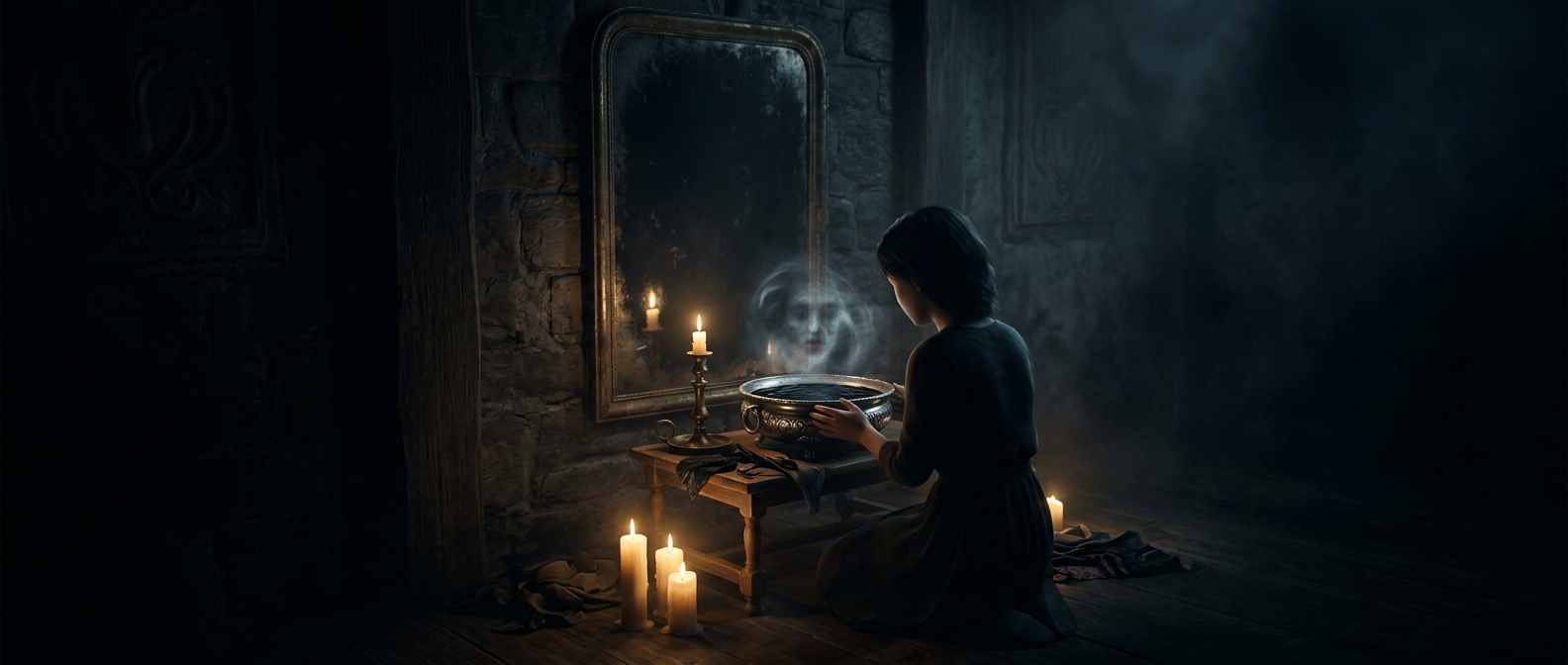
Scrying is the practice of looking into a reflective or otherwise featureless surface in search of meaningful images. A mirror does not supply a clear prediction; its dim, shifting reflections give the viewer room to interpret what appears. In traditional fortune-telling, the image might be treated as a sign rather than as an ordinary reflection.
The stairway ritual used that ambiguity in a highly specific question: who would a young woman marry? Walking backward while holding a mirror made the act feel like a test of fate, with the future husband’s face imagined as the answer. A skull carried the opposite, ominous meaning: death before marriage.
Why the ritual could feel convincing
In low light, a face in a mirror can become difficult to make out. Shadows and small changes in the angle of the glass may make features seem to shift, while expectation guides what the viewer thinks she sees. That does not explain away the ritual’s meaning to participants; it helps show why a mirror was such a potent setting for a vision. The object offered a real, visible surface on which an uncertain future could be imagined.
Bloody Mary draws on the same basic ingredients: a darkened room, a mirror, and the expectation that something will appear. Scrying is the older, broader practice behind that kind of mirror divination, while the childhood game turns the encounter into a repeated, shared dare. The striking continuity is not a guaranteed glimpse of the future, but the mirror’s ability to make a question feel as if it might answer back.