Why Jurassic Park needed more than a child’s point of view
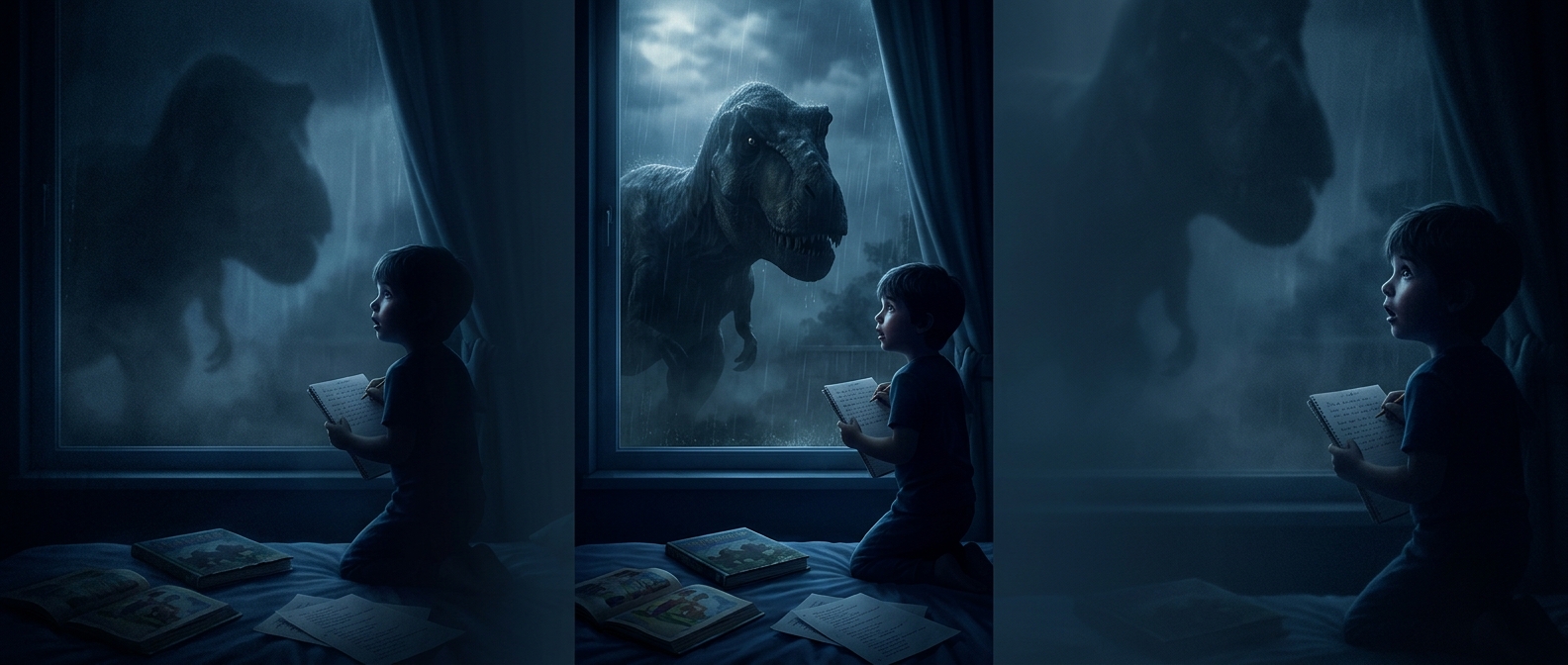
A frightened young visitor can make a dinosaur encounter feel immediate: the creature is large, the danger is close, and the child has little power to make sense of either. But a story built only around that experience would leave a different question hanging: how did a dinosaur park become possible, and why is it falling apart?
The finished story broadens the viewpoint. Children still face the danger directly, while adults bring different kinds of knowledge to the crisis: paleontology, computing, park management, and the study of complex systems. That lets the story move between suspense and explanation without making the children responsible for understanding every failure.
Chaos theory gives the breakdown a human voice
Ian Malcolm, the cynical chaos theorist, helps articulate the park’s central problem: a complicated system can behave in ways its designers cannot reliably predict. In plain terms, controlling many interacting parts is not the same as controlling the whole. A change in one place can produce consequences elsewhere, and confidence in a plan can outstrip the ability to foresee its effects.
That idea makes Malcolm more than a commentator on the dinosaurs. He gives the audience a way to think about the gap between the park’s promise of control and the disorder unfolding inside it. The adults’ explanations also make the danger legible, while the children’s vulnerability keeps it personal.
The result is a story with two scales of tension: the immediate fear of being hunted and the larger failure of a system built to manage life as if it were fully predictable.