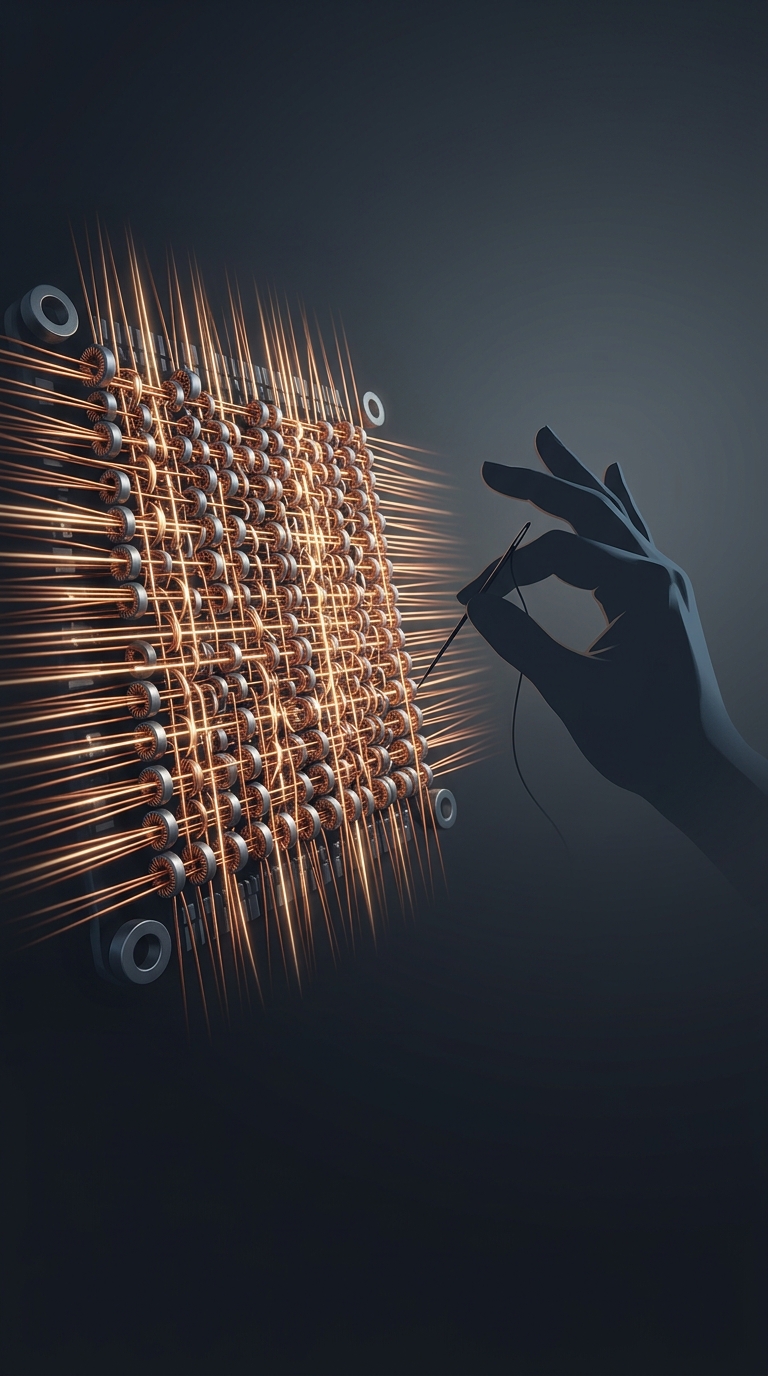
How Apollo’s software became a physical pattern
The Apollo Guidance Computer had to carry its programs into space in a compact, reliable form. One solution was core rope memory: instead of storing program instructions in a form that could be freely rewritten, it encoded them in the paths of wires threaded through tiny magnetic cores.
Each core acted like a small ring. A wire routed through it represented one binary value; a wire routed around it represented the other. A group of these choices formed the bit patterns the computer read as instructions and data. The pattern was built into the hardware, so the memory was effectively read-only during flight.
From software design to careful handwork
Margaret Hamilton’s software team developed the instructions the Apollo computer needed to carry out its tasks. To put those instructions into rope memory, the planned bit patterns had to be translated into exact wire routes. Skilled workers, including women experienced in fine handwork, threaded the wires through or around the cores according to those patterns.
The workers were not composing the program as they stitched. They were physically encoding a design created upstream—and accuracy mattered: a misplaced wire could change what the computer read. The result was a striking bridge between software and manufacturing: a program that could be inspected, in principle, as a tangible arrangement of wires.
Why make memory this way?
A fixed pattern could be dependable and compact, qualities that mattered in a spacecraft where a failed computer or corrupted program could have serious consequences. The tradeoff was flexibility. Changing an instruction was not like editing a file; it could require making a new memory module, so the software and its encoding had to be checked with care before flight.
Apollo’s computer therefore carried its program not just as an abstract sequence of ones and zeros, but as a physical object whose wire paths embodied those choices.