The signal changed; the antenna did not
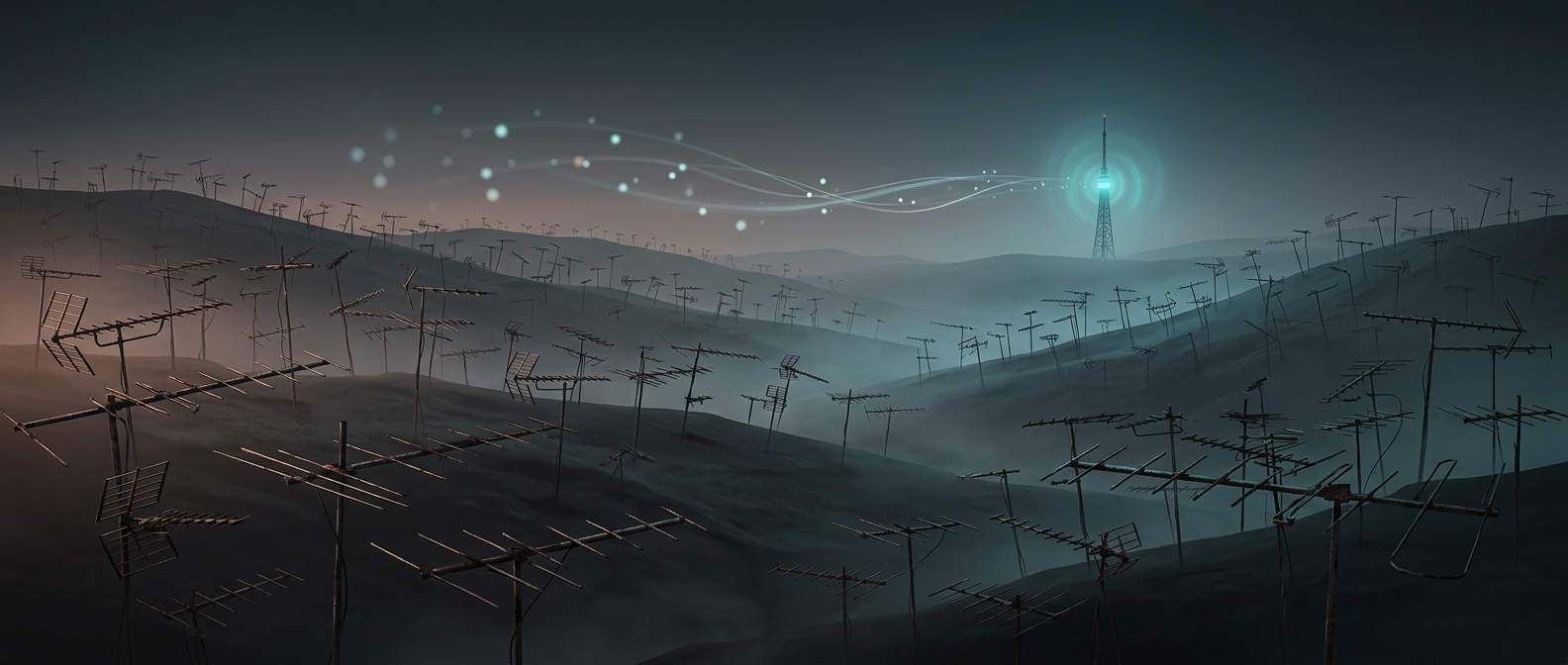
An antenna’s job is to capture radio waves traveling through the air. It does not know whether those waves carry an old-style analog picture or a digital one. The change in television broadcasting altered the information encoded in the waves—not the basic physics of receiving them.
The mismatch appeared inside older televisions. Their built-in tuners were designed to interpret analog broadcasts, where picture and sound were transmitted as continuously varying signals. Digital broadcasts encode them as data, which must be decoded before a screen can display the program. An old TV could still pick up the broadcast energy, but its tuner could not turn that new format into a picture.
Why a converter box worked
A converter box supplied the missing step. It received the digital broadcast, decoded the program, and sent the older television an analog signal it could understand. The antenna could stay connected to the box; the box, in turn, connected to the TV. In effect, it acted as a translator between a newer broadcast system and older display hardware.
That distinction explains why the transition could make familiar setups seem to fail all at once. A rooftop or indoor antenna might be intact and positioned just as before, yet the television would show no usable picture because the equipment interpreting the signal had become incompatible. Replacing the antenna would not solve that problem; adding a digital tuner or converter would.
The practical lesson is that an antenna and a television tuner do different jobs. One gathers the broadcast; the other makes sense of it. When broadcasting standards change, the receiver—not necessarily the piece of metal on the roof—is often what needs replacing.