Why a 100-Sided Die Keeps Moving
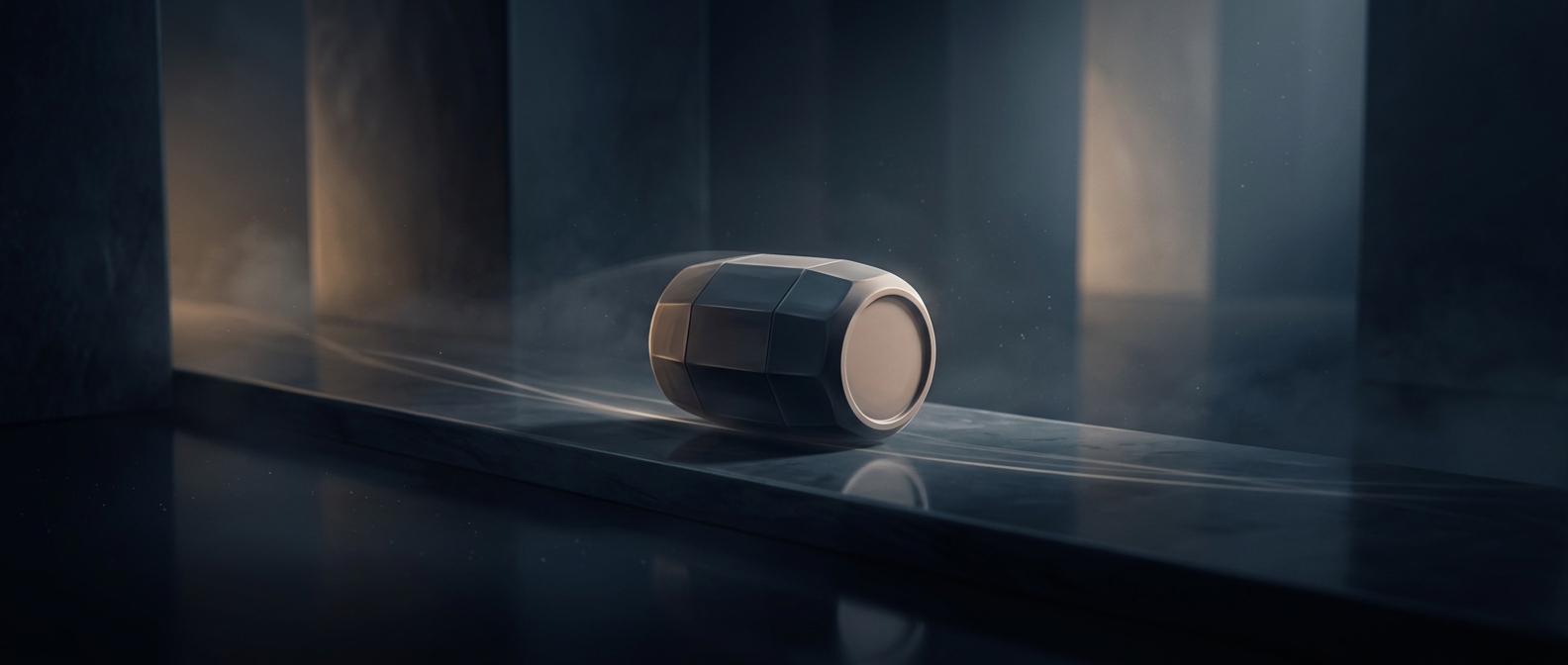
A cube tends to stop decisively: it tips from one broad face to another, and each landing gives friction and the impact a chance to drain away motion. A hundred-sided die has a very different shape. Its many small, flat faces make its outline nearly spherical, more like a golf ball than a block.
That geometry changes how it loses energy. As the die rolls, it crosses a succession of shallow facets rather than making large, abrupt tumbles. Each change in orientation nudges its motion, but usually does not produce the dramatic impact that would quickly bring a cube to rest. The die can keep rolling, wobbling, and changing direction as it sheds energy bit by bit.
A Near-Sphere Has Few Decisive Landings
On a cube, gravity helps the die settle into a stable face: tipping it away from that position requires lifting its center of mass. On a many-faceted die, neighboring resting positions are much more alike. Its center barely rises or falls as it moves from one tiny face to the next, so there is less of a pronounced “drop” into a final position.
Friction and collisions still stop it; the die does not roll indefinitely. But its shape gives those forces a longer, less dramatic job. That is why a hundred-sided die can travel across the table like a little ball before it finally settles on one of its many facets.