The escape route opens before the blast
When a massive star’s core collapses, its inner material is squeezed to extraordinary density. The collapse releases an immense amount of gravitational energy, but the star’s outer layers are so packed that photons—the particles of light—cannot travel straight out. They scatter repeatedly off matter, effectively trapped as the core and surrounding layers change violently.
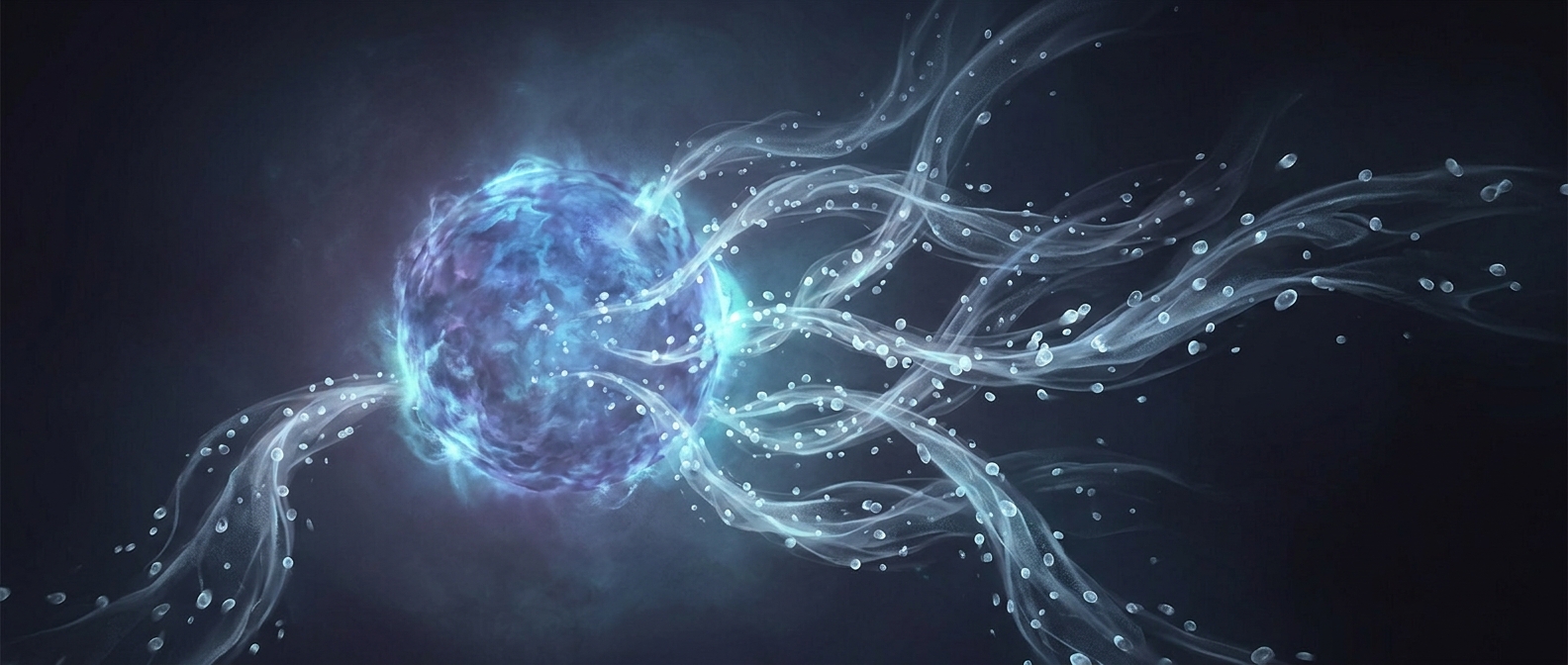
Neutrinos take a different route. They have no electric charge and interact with matter only through the weak nuclear force, one of nature’s fundamental forces. That makes them extraordinarily difficult to stop: most pass through the dense star without interacting, carrying energy away from the collapsing core.
A flood that barely touches the star
The core briefly becomes so dense that even neutrinos are produced in huge numbers and can scatter or be absorbed. But compared with photons, they still escape far more readily. In the minutes around collapse, an enormous burst streams outward through the star and into space. The energy carried by that burst is roughly 99 percent of the total released in the collapse; the visible explosion accounts for only a small share.
That imbalance helps explain why a supernova’s bright display is not a direct measure of its energy budget. The light we eventually see comes from energy that has been deposited in the star’s material and from radioactive decay in the expanding debris. Neutrinos, by contrast, leave with most of the energy before it can become light.
The particles arrive first
Because neutrinos pass through matter so readily, they can escape from deep inside the collapsing core before the shock wave has worked its way outward and the star becomes visibly bright. They offer a rare signal from the hidden interior of a supernova: the star’s most powerful energy release is carried away by particles that can cross the entire star almost as if it were not there.