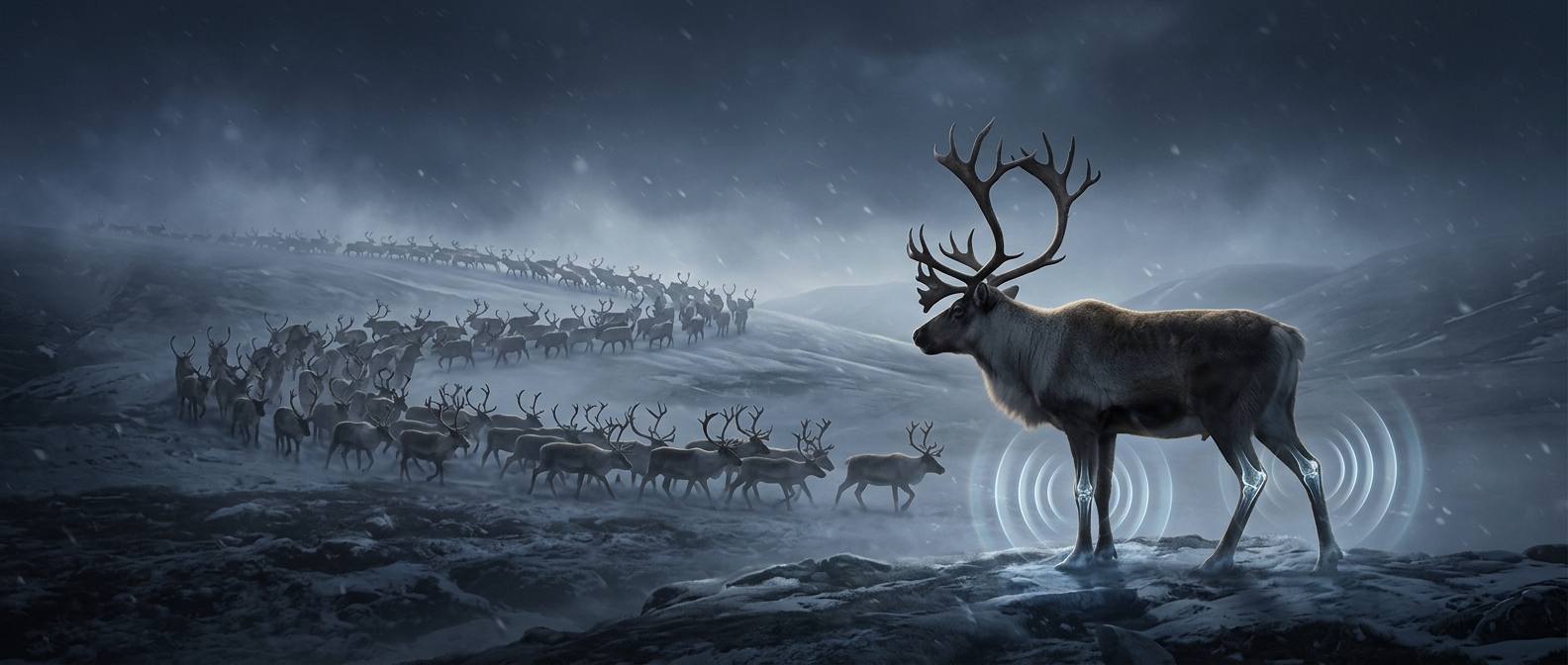
A tendon turns each step into a sound
Inside a reindeer’s lower leg, a tendon passes over a small bone near the knee. As the leg bends and straightens, the tendon shifts across that bone and produces a distinct click. The sound is tied to the animal’s movement, so walking creates a repeated series of cues rather than one continuous call.
A useful signal when sight fails
In a snowstorm, blowing snow can make nearby herd members difficult to see. Their clicks give one another another way to keep track of where the group is moving. The sound does not need to carry a detailed message: a steady pattern of nearby steps can help an animal stay with the herd when visual contact is unreliable.
That makes the click a practical, built-in aid to group travel. Each reindeer produces it simply by walking, without stopping to call or using energy to make a separate signal. In a whiteout, the herd’s movement can remain audible even when its members disappear from view.