A message designed to stay unseen
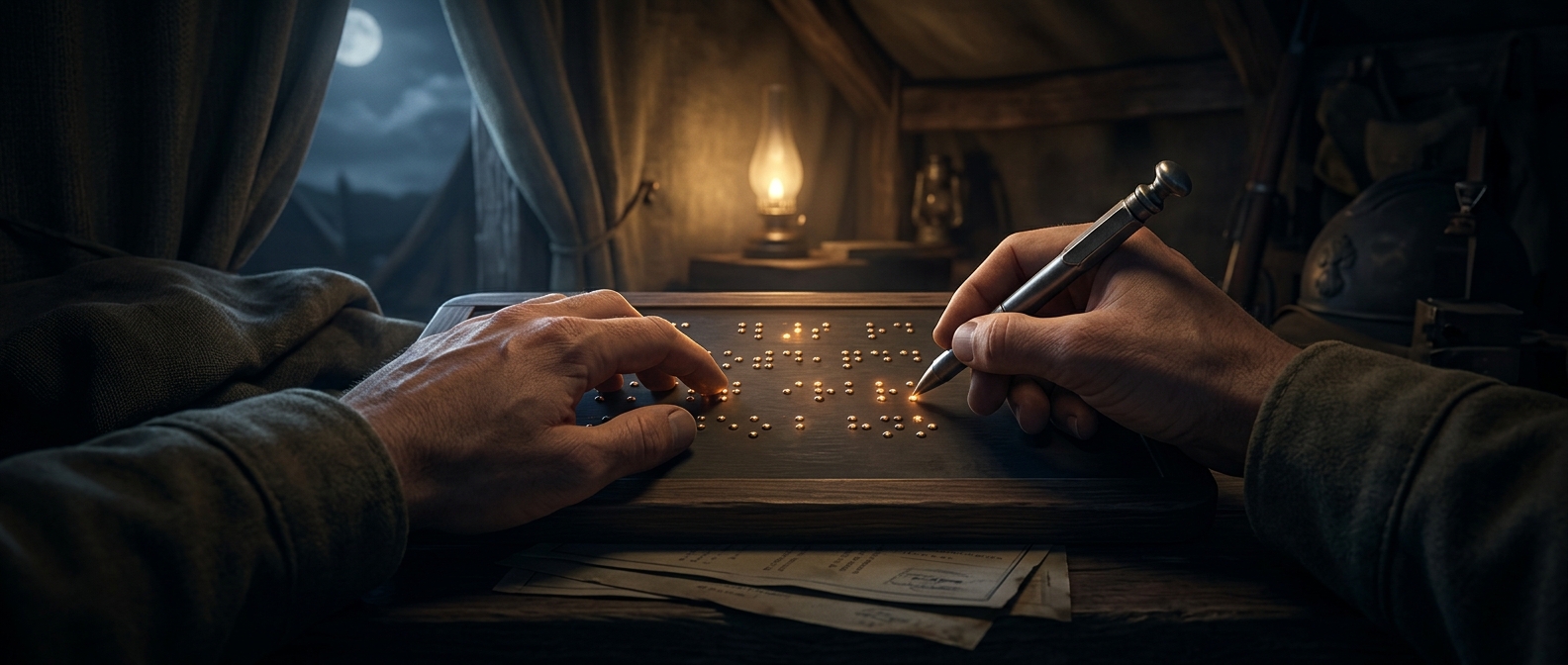
In the early 19th century, French artillery officer Charles Barbier devised a tactile code called “night writing.” Its purpose was to let soldiers read messages in darkness without lighting a candle or lamp that could reveal their position. Instead of inked letters, the code used patterns of raised dots that a reader could feel with a fingertip.
The idea tackled a real battlefield problem, but Barbier’s system was difficult to use. Its cells were large, and it represented sounds rather than ordinary letters, making reading and writing cumbersome. The military purpose also shaped the design: it was built for transmitting messages, not for the full range of reading and writing.
From battlefield code to everyday literacy
Louis Braille encountered Barbier’s system as a student at a school for blind pupils in Paris. He recognized the potential of raised dots but redesigned the code into compact cells of up to six dots. A fingertip could cover a cell, allowing readers to distinguish patterns quickly; combinations of those dots could represent letters and other symbols.
That change made the system practical not just for receiving a secret message, but for reading and writing across subjects. Braille’s lasting innovation was turning a tactical code into a compact alphabet that could support literacy. The same basic principle—small patterns of raised dots read by touch—still lets a page be read without light at all.