Why radar coverage ends over open water
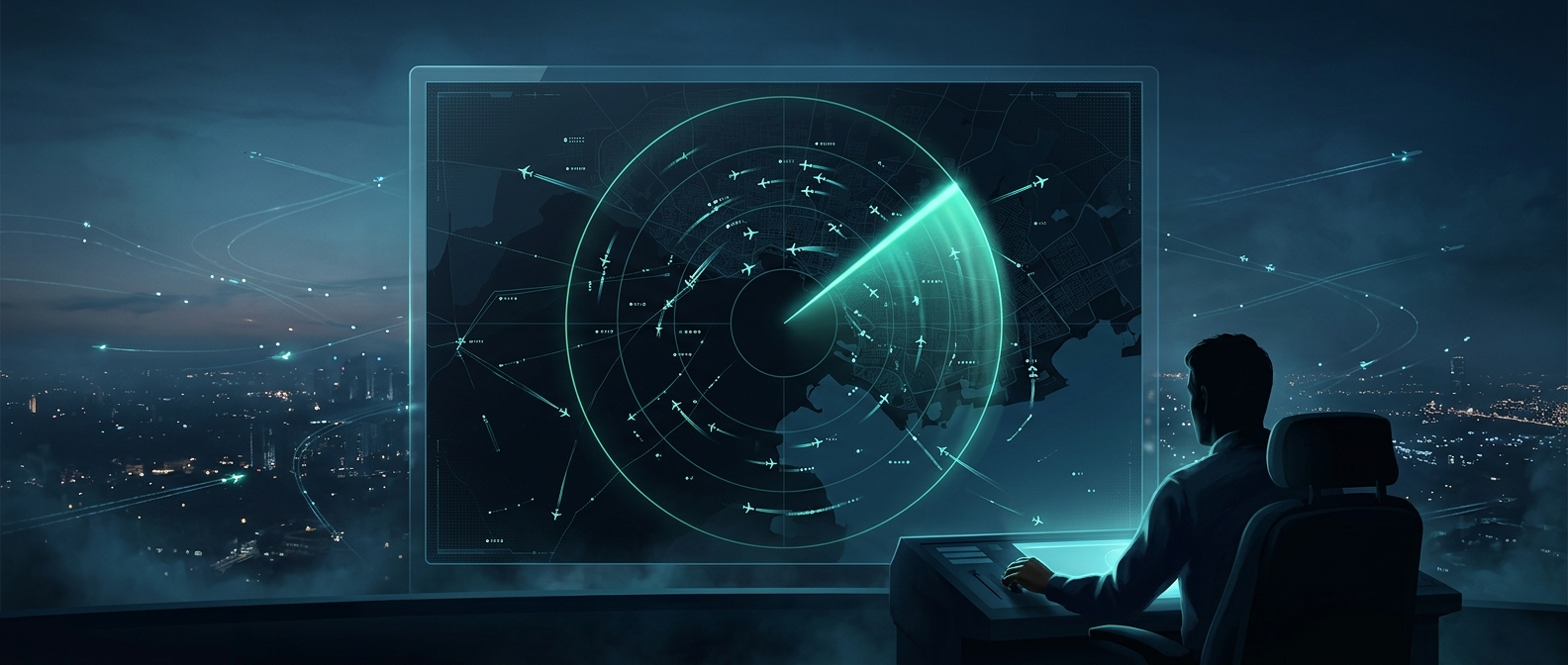
Most air traffic radar works by sending out radio waves and detecting their reflections from aircraft. Because those waves travel roughly in straight lines, the radar antenna must be within a practical line of sight. A plane may be high above the ocean, but it can still be far beyond the reach of antennas on shore.
That does not mean controllers lose all knowledge of it. Before an ocean crossing, a flight is assigned a route and planned altitude. Its crew and controllers coordinate when it will enter oceanic airspace, and the flight follows the clearances it receives.
How controllers track aircraft without radar
In areas without continuous radar coverage, control is often procedural: controllers maintain separation using planned routes, altitude assignments, and position reports rather than watching a live radar target. A report may give the aircraft’s position, altitude, and the time it passed a point along its route. Crews can send reports by radio or through a digital data link, depending on the equipment and coverage available.
These reports let controllers update their picture of where aircraft are and predict where they will be next. Separation rules build in room for uncertainty and account for the time it takes aircraft to cover the distance between reports. If a flight needs to change altitude or route, its crew coordinates that change with oceanic control rather than simply choosing a new path.
Satellites extend the view
Satellite communications can carry messages between aircraft and controllers far from ground stations. Some aircraft also send tracking information through satellite-based systems, allowing their positions to be monitored over oceanic routes. The precise capabilities depend on the aircraft, route, and available service; satellite links supplement the procedures rather than making every oceanic flight identical to a radar-tracked flight.
The practical result is a different kind of oversight, not an unsupervised gap. A controller may not see the plane as a continuously refreshed dot, but the flight remains part of a carefully coordinated traffic system—one built around scheduled updates, assigned separation, and communication.