Water is a hard boundary, not a route
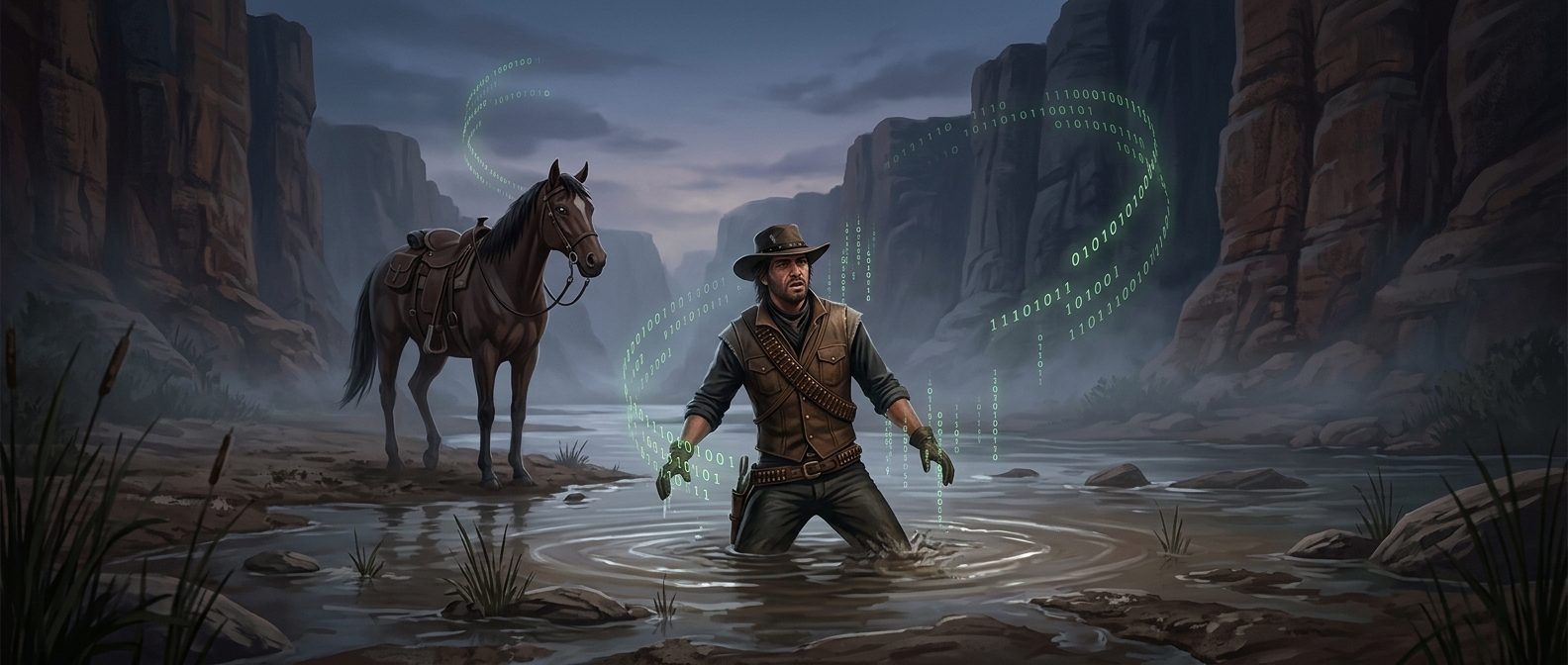
Most open-world games treat water as another surface to navigate: the character changes movement, begins swimming, and keeps going. Red Dead Redemption draws a sharper line. Once the water is too deep to wade through, John’s ordinary movement has nowhere to go—and the game has no swimming mode to take over. The result is a lethal boundary rather than a slower way across.
That makes rivers and lakes function differently from cliffs or locked doors. They can look like open space on the landscape, but they divide the usable world into separate areas. A player who rides straight toward the opposite bank may discover too late that the apparent shortcut is not a crossing.
The map becomes a route puzzle
The practical solution is to read the terrain: follow a riverbank, look for a bridge, or find a shallow ford—a place where the water can be crossed on foot or horseback. Water therefore shapes travel even when no mission explicitly asks the player to cross it. It can turn a direct line into a detour and make a familiar route feel safer than an improvised one.
The contrast is especially striking because the game lets John endure dangers that would normally be fatal. That toughness belongs to its combat and action systems; it does not make him universally invulnerable. His limits depend on what the game has built a mechanic for: bullets and explosions have systems that let play continue, while deep water does not offer a swimming system at all. The result is a small but memorable rule: in a world where John can survive a firefight, a river may still be the thing that stops him.