A rosette built for one great flowering
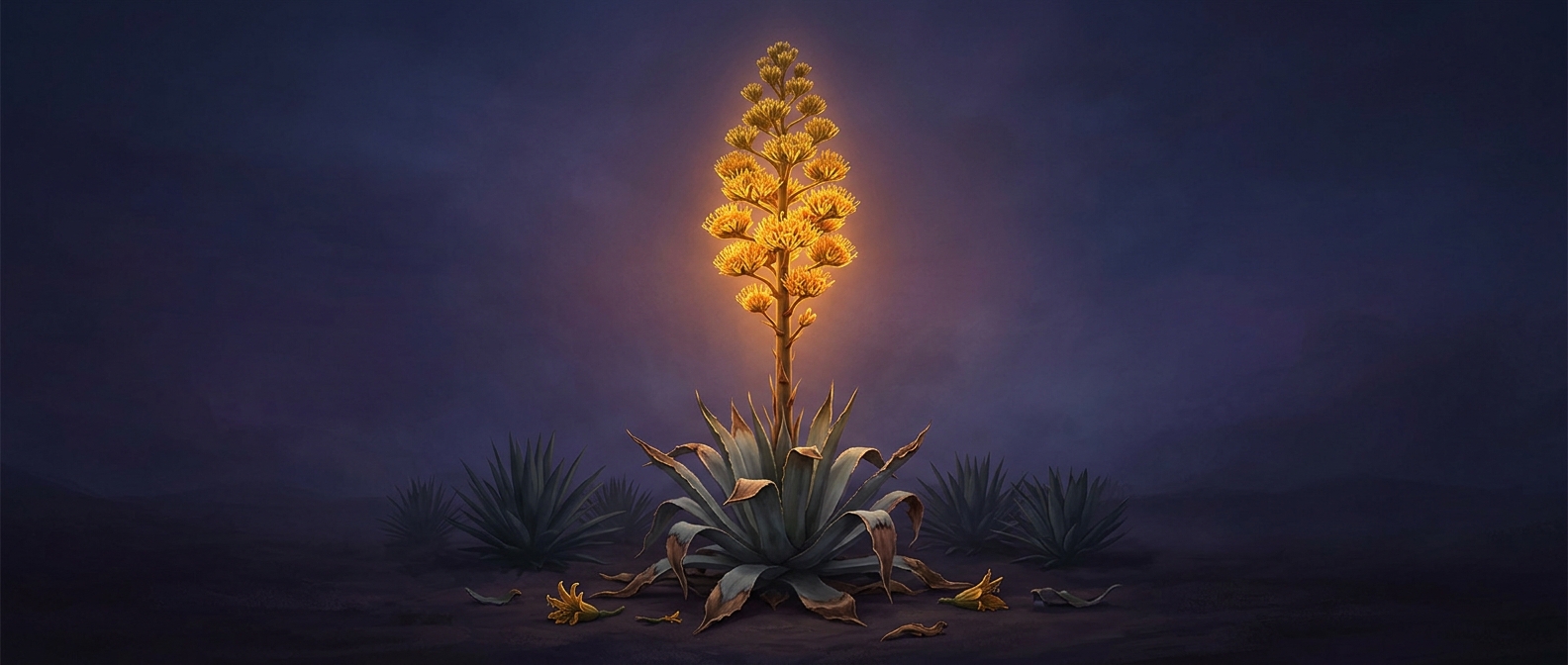
An agave’s leaves form a tight rosette around a single growing point. In many species, that point eventually changes from making leaves to making a flower stalk—a shift called monocarpy, meaning the plant flowers once and then dies. Depending on the species and growing conditions, that moment may come after years or even decades.
The stalk is expensive to build. The agave draws on resources stored in its thick leaves and underground tissues to push it upward and produce flowers. Once the growing point has become reproductive, it cannot return to making a fresh circle of leaves. After flowering, the main rosette gradually declines and dies; it does not necessarily disappear as soon as seeds form.
Two ways to carry the plant forward
Flowers can produce seeds, which grow into genetically varied plants. Agaves can also make offsets, or pups: new rosettes growing from the base or nearby underground stems. Pups are essentially clones of the parent, so they preserve the same genetic makeup.
These routes have different payoffs. Seeds can travel and establish agaves in new places, while pups can keep a plant’s lineage going close to where it already grows. If pups are present, the parent’s death need not mean the end of the local cluster: the old rosette gives way, and younger copies continue growing around it.