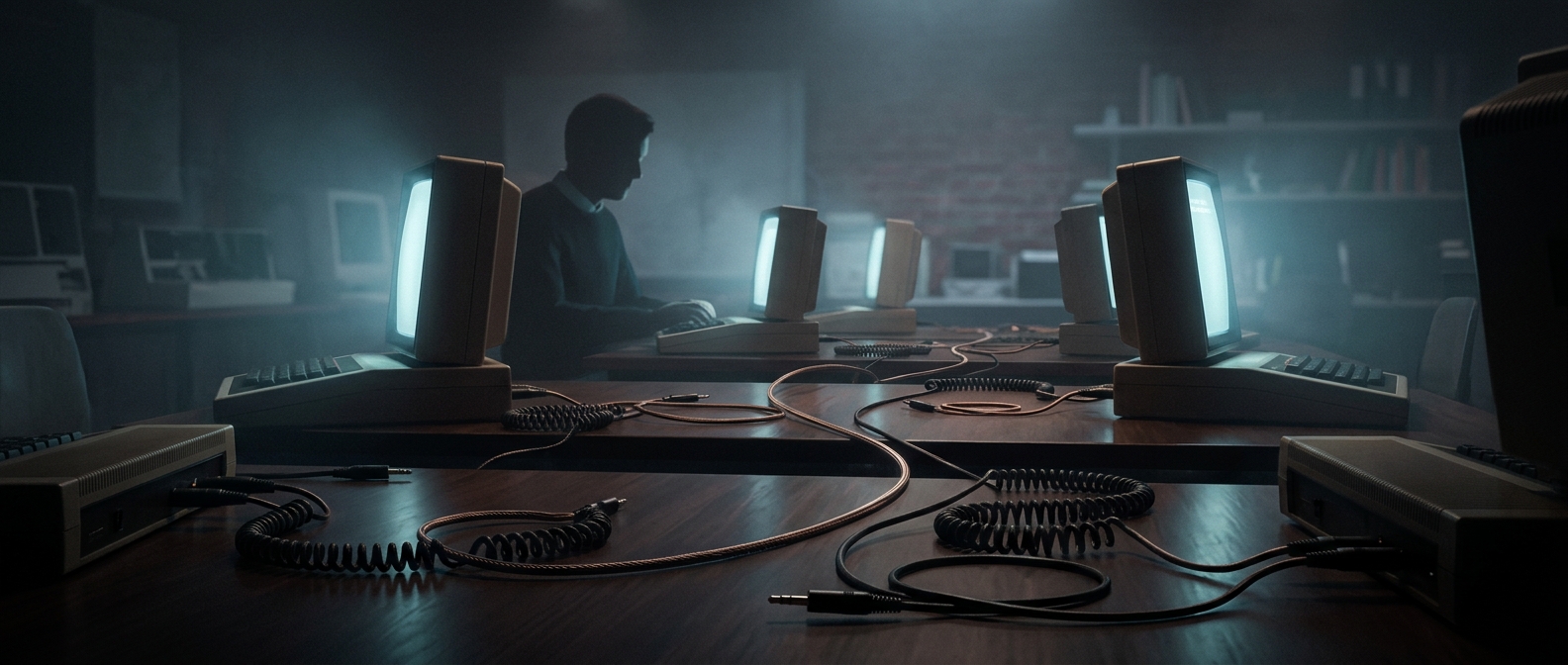
A school network built around a shared line
Econet gave Acorn computers a way to share resources rather than operate as isolated machines. A school could connect classroom computers to services such as a shared file server or printer, making it easier to distribute and save work without equipping every desk with its own storage and peripherals.
The connection was a simple serial network: computers joined a common cable instead of each needing a separate link to every other machine. That kept installation relatively inexpensive, but it also made the cable itself part of the system’s weak point. A loose or damaged connection could interfere with communication along the line, affecting machines beyond the desk where the bump happened.
Familiar plugs, demanding conditions
The five-pin DIN plug was a practical choice in a cost-conscious setting. It was a readily available connector, and its shape made it straightforward to plug into a computer. But a connector’s familiarity does not make it rugged. Classroom cables were exposed to chairs, feet, moved desks, and repeated plugging and unplugging; an unshielded cable offered little protection against physical disturbance.
That tradeoff captured an early-school-networking challenge: the electronics could make computers cooperate, but the network still depended on a fragile piece of wiring stretched through a busy room. When the connection failed, the result was not merely a bad cable at one workstation—it could interrupt the shared services that made the network useful in the first place.