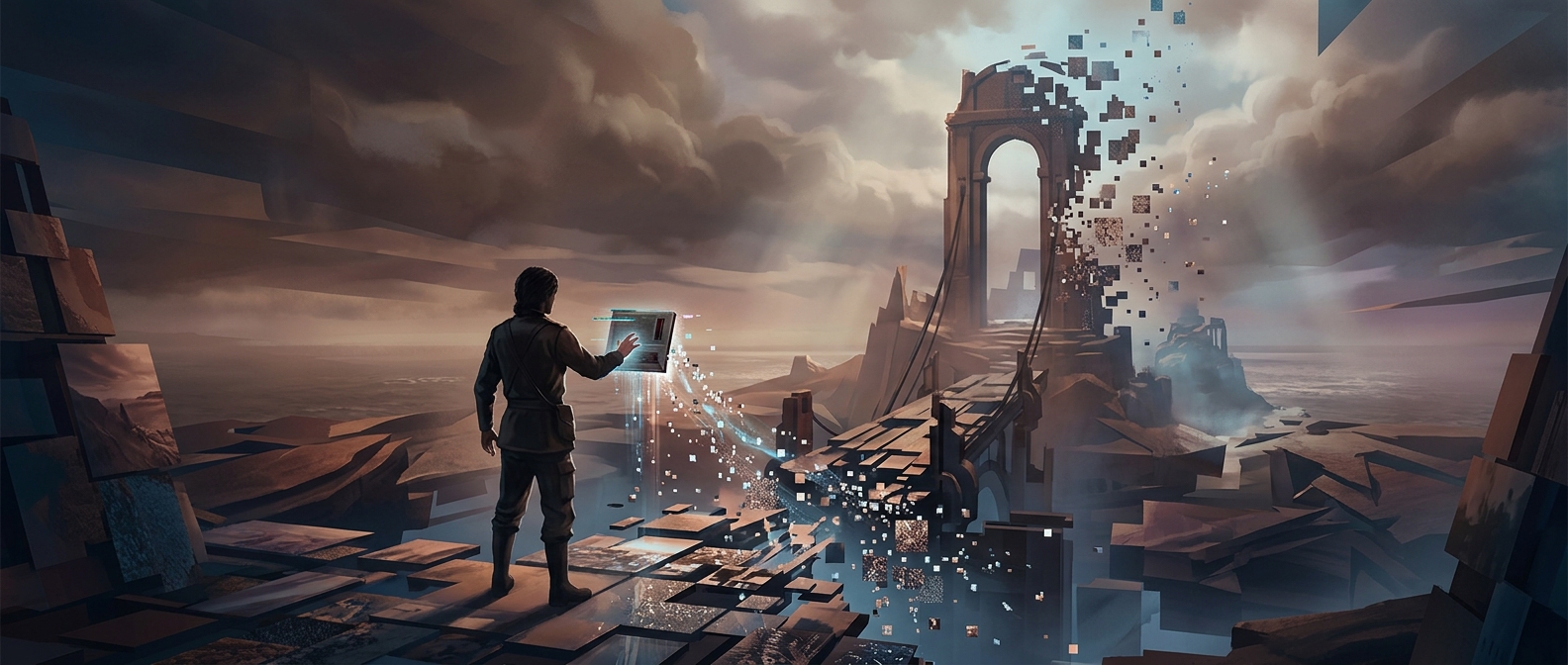
How Myst made still images feel like a world
In Myst, moving through an island did not mean a computer was continuously drawing a 3D scene from your viewpoint. Instead, the game displayed carefully composed images, then switched to another image when you clicked a place to go. These pre-rendered scenes had already been made to look three-dimensional before they reached the player’s computer.
The trick was to make each still image feel like a stopping point in a larger space. Doorways, paths, stairs, and distant landmarks suggested where you could travel next. Clicking a visible route triggered a transition to the next view, much like turning a page in a book whose illustrations happen to connect.
Why that approach worked
Real-time 3D games must calculate a changing view as the player moves and turns. That demands computing power. Myst sidestepped much of that work: its images could show elaborate lighting, textures, and architecture without requiring the computer to recreate those details on the fly. The tradeoff was freedom. Players could explore only the viewpoints and paths the creators had prepared, rather than move anywhere or look in any direction.
That constraint also shaped the game’s pacing. A click carried the player between composed scenes, giving each location time to register. The island felt spatial because its views were linked coherently, but exploration unfolded as a sequence of chosen perspectives rather than continuous movement.
The world between the pictures
The images alone were not the whole experience. Sounds, animation, and interactive objects helped make the still scenes feel inhabited and responsive. Players could inspect mechanisms, uncover clues, and change what happened next, even though the surrounding scenery was largely presented as fixed views.
The result was a useful illusion: a world could feel explorable without being rendered as a freely moving 3D space. Its boundaries were real, but because the next view was often just a click away, players could experience those boundaries as paths through an island.