How a stent reaches a narrowed artery
A stent is delivered from outside the body through a catheter—a thin, flexible tube threaded into a blood vessel. The doctor guides it to the narrowed section, often using X-ray imaging to see where the catheter is. The stent stays folded around a small balloon during the journey, so it can pass through vessels much narrower than its expanded size.
A balloon opens the vessel—and leaves support behind
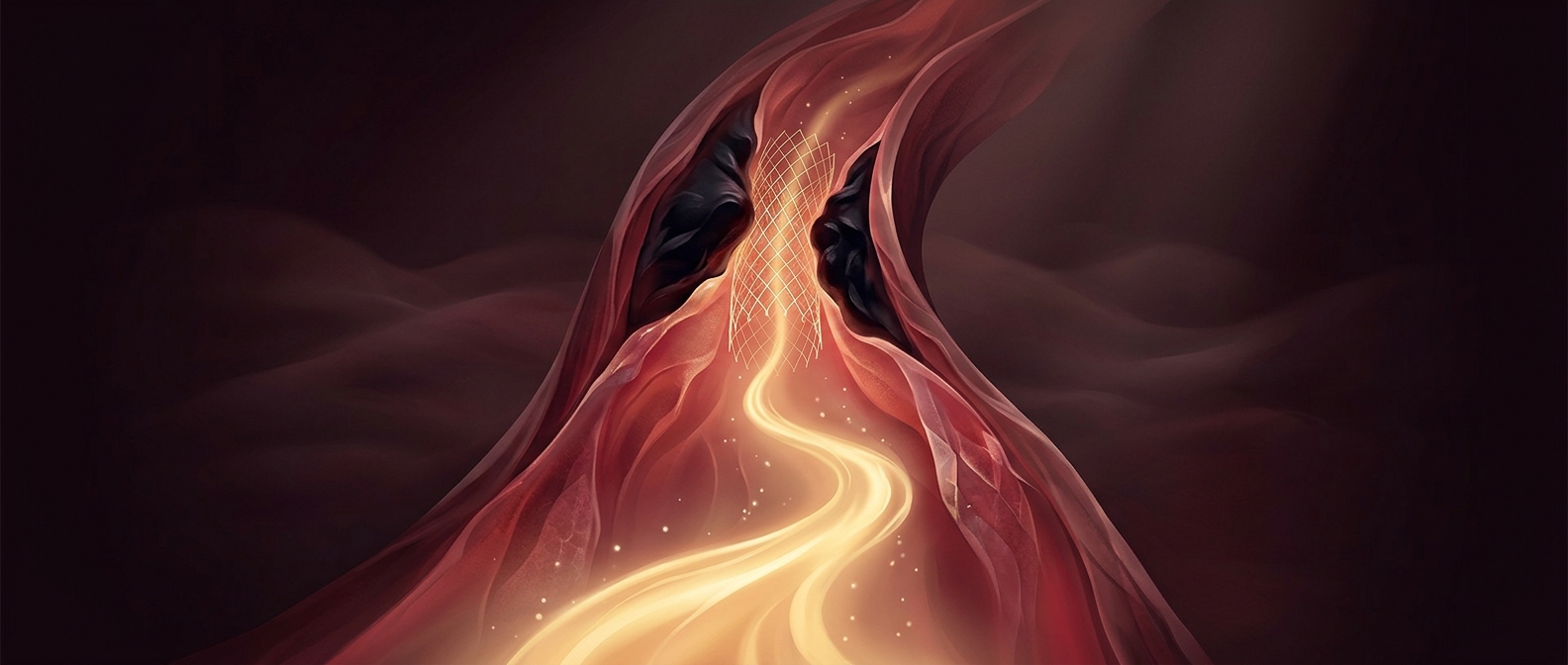
Once the stent is in position, the balloon inflates. It pushes the mesh outward against the artery wall, widening the channel for blood to flow. The balloon is then deflated and withdrawn; the stent remains as a scaffold that helps keep the vessel open.
That support matters because treating a narrowing can leave the vessel prone to closing again. The stent holds the treated area open while the artery heals around it. Many stents are made of metal, and some carry a medicine that slowly reduces tissue growth inside the vessel—a response that could otherwise narrow the opening again.
The scaffold becomes part of the vessel
The mesh is designed to stay in place rather than be removed after recovery. Over time, the artery’s inner lining grows across it, covering the struts. The result is not a tube replacing the artery, but a small internal framework embedded in its wall—one that lets blood pass through the restored opening.