A library too vast to verify
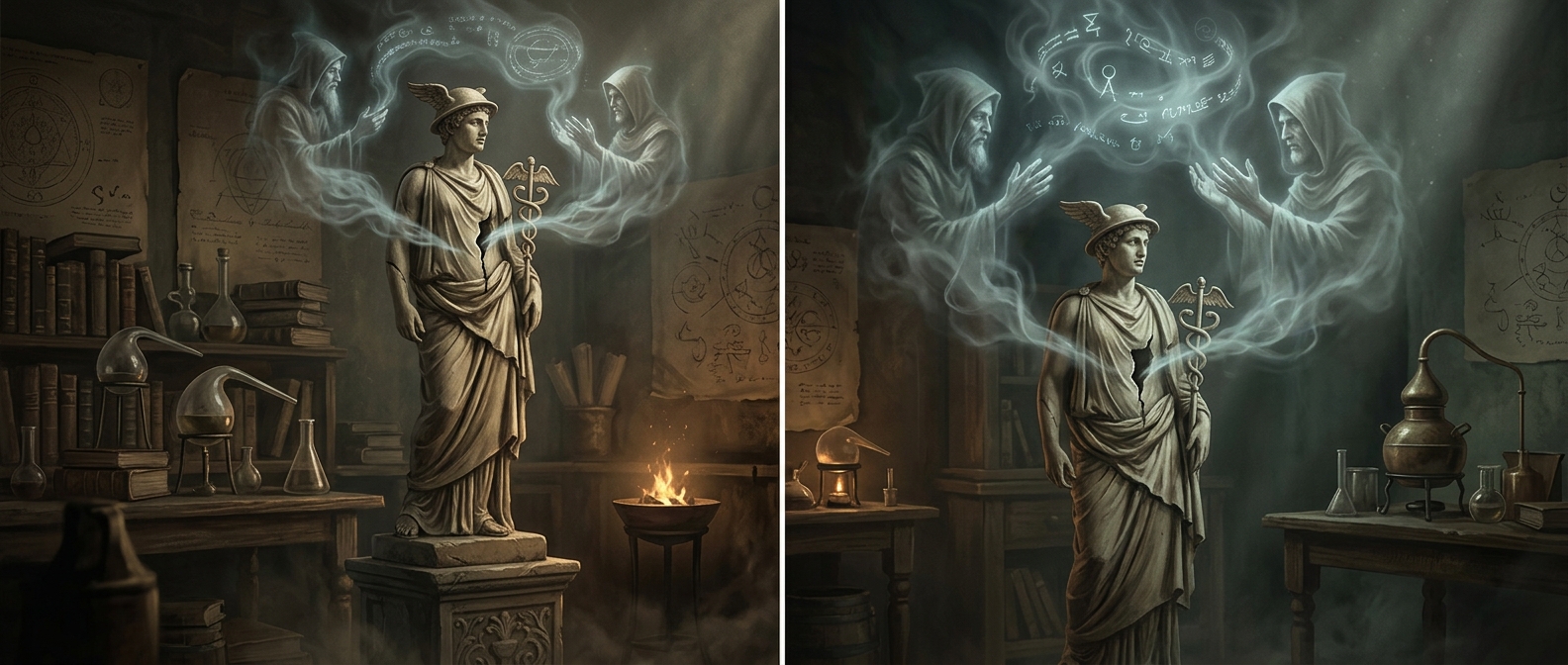
Hermes Trismegistus was a legendary sage whose name joined the Greek god Hermes with the Egyptian god Thoth, both associated with writing and knowledge. Later traditions credited him with an almost unimaginable library: 36,525 books on subjects such as the cosmos, alchemy, and astrology. The number made the claim feel less like an ordinary author’s bibliography and more like a body of wisdom spanning the world.
What survived
Texts now called Hermetic writings do exist, but they are a limited collection of works rather than the vast library described in the legend. Many are dialogues about the soul, the divine, and the structure of the universe. They present wisdom as something passed from a teacher to a student—not merely as information to be collected in books.
That difference matters. A short surviving dialogue could be treated as a fragment of a much larger teaching, rather than as the whole of what Hermes supposedly knew. The missing books were said to have been hidden or destroyed, explanations that kept the legend intact even when the promised library could not be found.
The power of the missing books
The story gave Hermetic ideas an extraordinary pedigree: a text attributed to Hermes could be received as ancient, sacred knowledge, not simply as one writer’s speculation. The legendary author therefore mattered as much as the surviving words. The absent library became part of the tradition itself—a sign, to its followers, that the deepest wisdom had not vanished so much as been concealed.