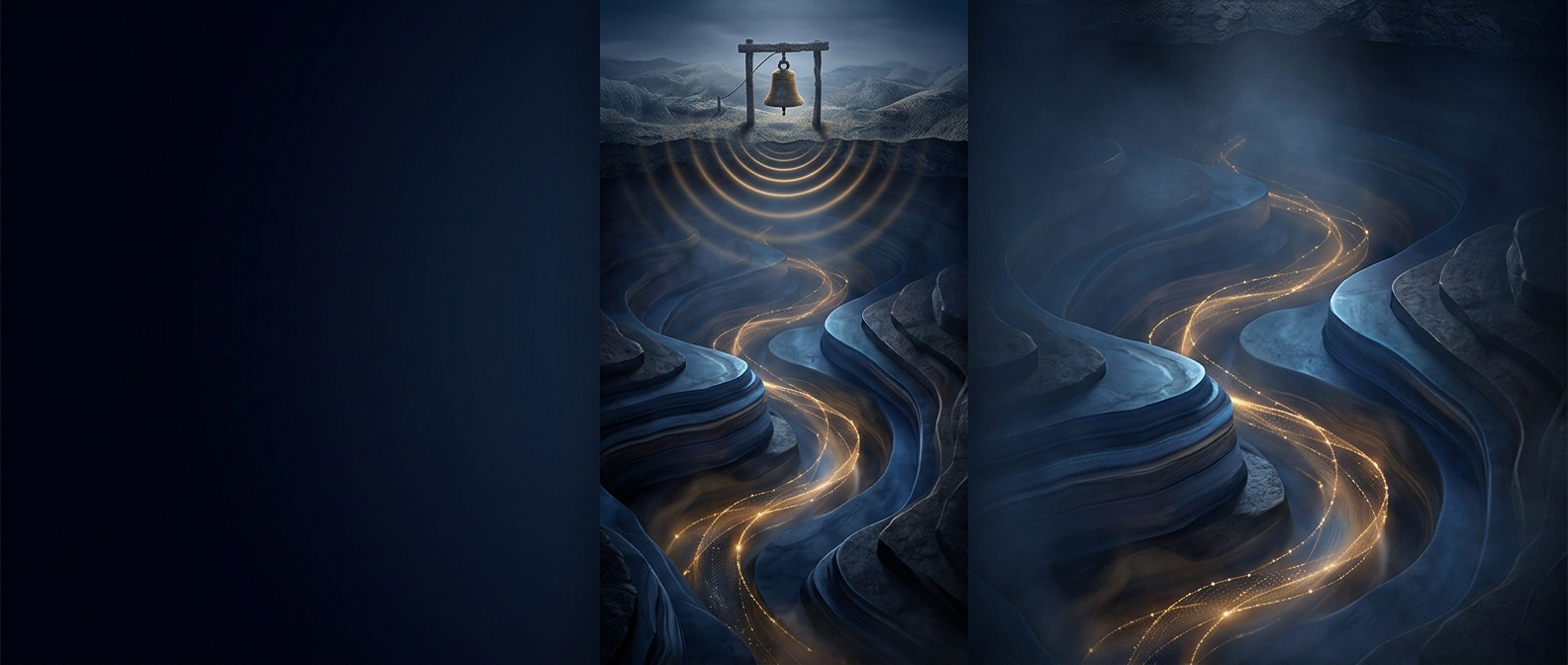
A faster path hidden beneath the surface
Earthquakes send vibrations through the planet, and seismographs record when those vibrations arrive. The first arrivals include P waves, which squeeze and stretch rock as they travel. Their speed depends on the material they pass through: in general, they move faster through the denser, more rigid rocks below the crust than through the rocks above.
That speed change creates a clue. A wave reaching a distant station can bend as it enters faster rock, much as light changes direction when it crosses into a different material. Some waves take a deeper route through the mantle and arrive sooner than waves traveling only through the crust. On a seismogram, the arrivals can appear as separate groups rather than one smooth sequence.
Reading the gap between arrivals
Scientists compare the arrival times at stations at different distances from an earthquake. If Earth’s interior were uniform, the timing would follow a simpler pattern. The sudden appearance of a faster route showed that the waves had crossed into a different layer at depth. From how the arrival times changed with distance, researchers could estimate where that transition lay.
The boundary is named the Mohorovičić discontinuity, usually shortened to the Moho, after the seismologist who recognized it. It is not a crack or an open gap inside Earth. It marks a change from crustal rock to mantle rock, and its depth varies from place to place. Earthquakes thus let researchers map a boundary they could not reach by drilling: the waves themselves carried evidence of the rocks beneath their paths.