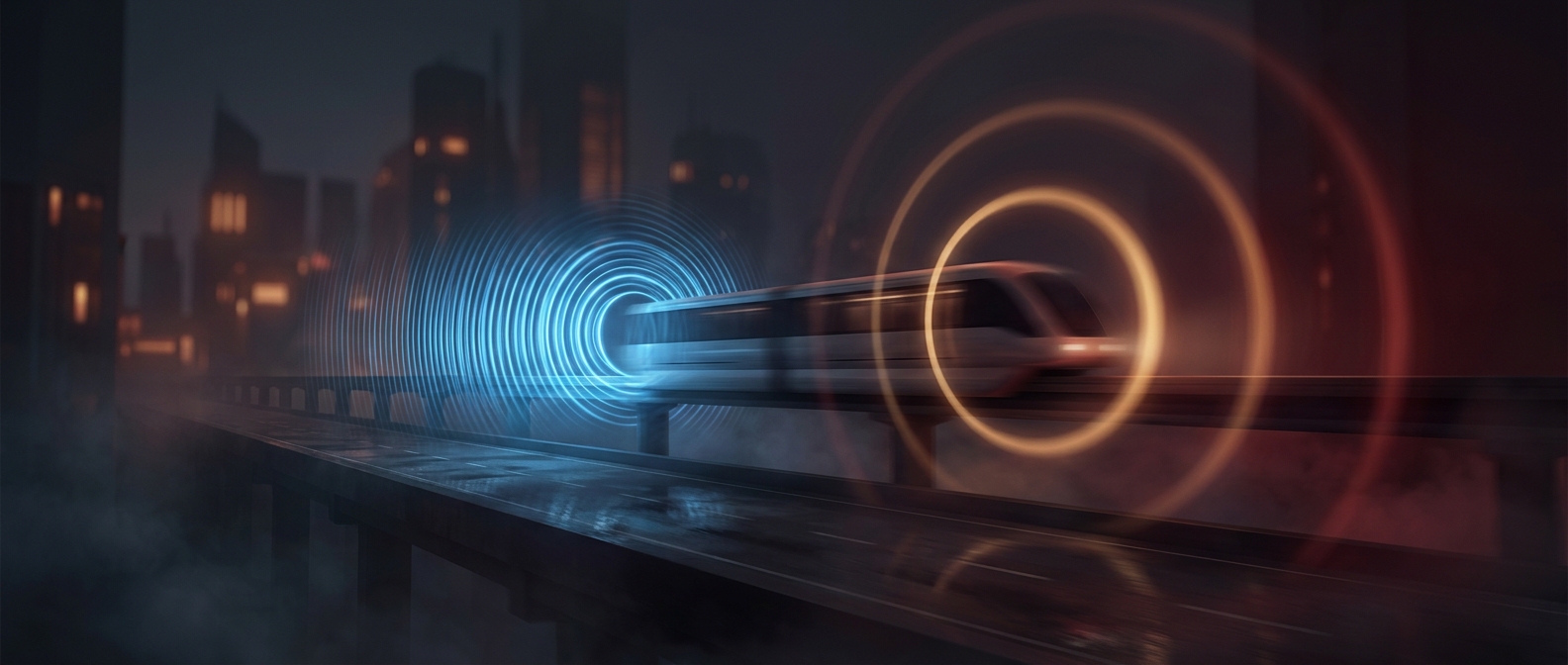
Why a siren’s pitch shifts as it passes
A siren sends sound through the air as a series of pressure waves. The pitch you hear depends on how often those waves reach your ears: more wave crests per second sound higher, and fewer sound lower. That arrival rate is the sound’s frequency.
While the siren moves toward you, it advances between one wave crest and the next. The crests in front of it end up closer together than they would be if the siren were standing still. As they pass your position, more crests arrive each second, so the siren sounds higher.
The change comes from spacing, not a new note
The siren does not need to alter its signal. Its motion changes the spacing of the waves traveling ahead of it. After it passes, it is moving away as it sends out new waves; those crests are spaced farther apart, so fewer reach you each second and the pitch sounds lower.
This shift in observed frequency caused by relative motion is called the Doppler effect. The same basic principle applies whenever a sound source and a listener move relative to each other, though the size of the shift depends on their motion.
The memorable “nee-yow” is therefore not the siren changing its tune at the moment it passes. It is the same sound arriving at different rates before and after the vehicle moves by.