How a falling domino powers the next
A standing domino has stored energy because its center of mass—the average location of its weight—is raised above the surface it will reach when the piece lies flat. Once the domino starts to tip, gravity pulls that center of mass downward. The lost gravitational potential energy becomes motion: the piece rotates, strikes its neighbor, and helps push it past the point where it can balance on its own.
The impact does not transfer all the first domino’s energy. Some is lost as sound, heat, vibration, and movement of the pieces. But the next domino also has gravitational energy waiting to be released. Each topple therefore combines energy passed along by the impact with energy supplied by gravity as that piece falls.
Why larger pieces can build a stronger chain
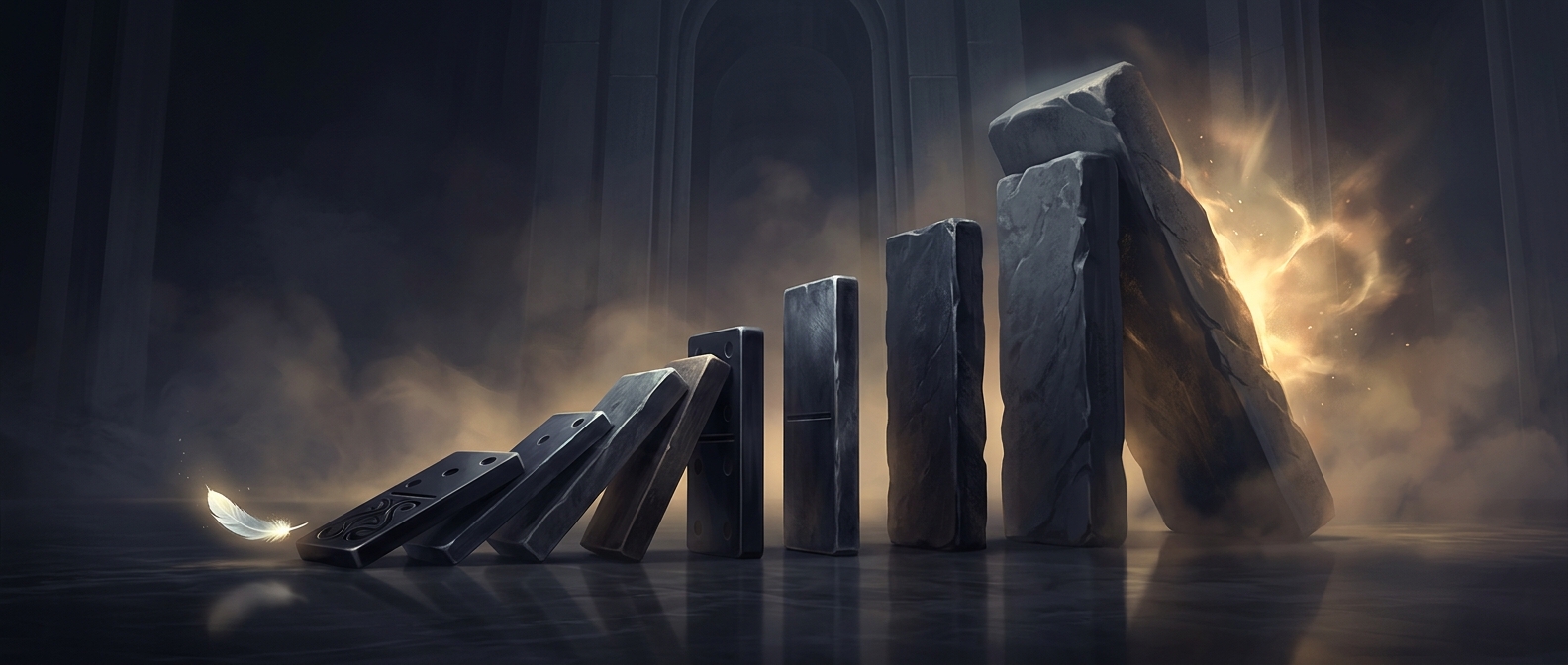
If each successive domino is larger, it can release more gravitational energy as it tips. A small first piece can trigger a much larger one, whose fall can then drive a still larger neighbor. The chain is not creating energy from the initial nudge; the nudge starts a sequence that draws on the energy stored in the raised pieces.
That growth has limits. A larger domino is also harder to set moving, and the impact must arrive with enough force, at the right height and angle, to tip it. If a piece is too large, too far away, or poorly aligned, the impact may not carry the next one past its balance point. Then the sequence stops.
The striking effect comes from this handoff: a tiny push can set much more energy in motion because gravity supplies energy at every fall. The first domino starts the process; the arrangement determines whether the rest can keep going.