Why a moving wind seems to bend
Earth rotates beneath the atmosphere. Because we experience motion from the rotating surface, a moving parcel of air appears to curve relative to the ground. This apparent deflection is the Coriolis effect: it does not push air into motion, but changes the direction of motion that is already underway.
In the Northern Hemisphere, moving air is deflected to the right of its path; in the Southern Hemisphere, to the left. The effect is weakest at the equator and grows stronger toward the poles. It is also more noticeable when air travels quickly or over a long distance. A brief gust covers too little ground for the small deflection to matter much.
How that shapes large storms
The energy that drives weather comes from uneven heating, which creates differences in air pressure. Air tends to flow from higher pressure toward lower pressure. As that flow travels across a wide region, Coriolis deflection continually turns it, helping organize winds into the broad rotating patterns seen in large weather systems.
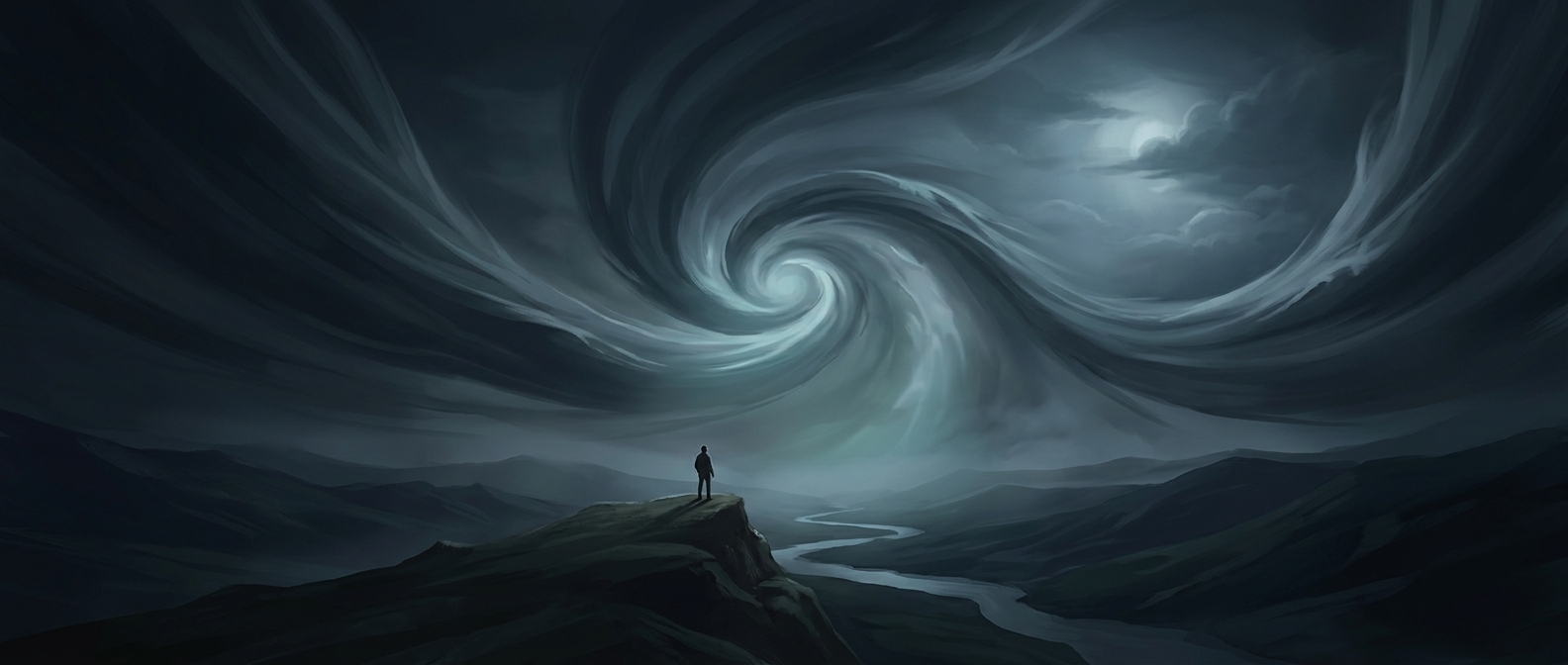
Around a low-pressure system, winds therefore spiral rather than rushing straight inward. The turning direction differs between hemispheres, while friction near the ground and other forces also affect the flow. Earth’s rotation helps shape a storm’s circulation; it is not what creates the storm’s winds. That distinction is why a passing gust may feel straight, even as a weather system hundreds of miles wide is steadily turning.