How Earth’s spin organizes storm winds
Air moves toward areas of lower pressure, but it does not travel in a perfectly straight line over long distances. Because Earth rotates beneath the moving air, the path appears to bend: to the right in the Northern Hemisphere and to the left in the Southern. This apparent deflection is called the Coriolis effect.
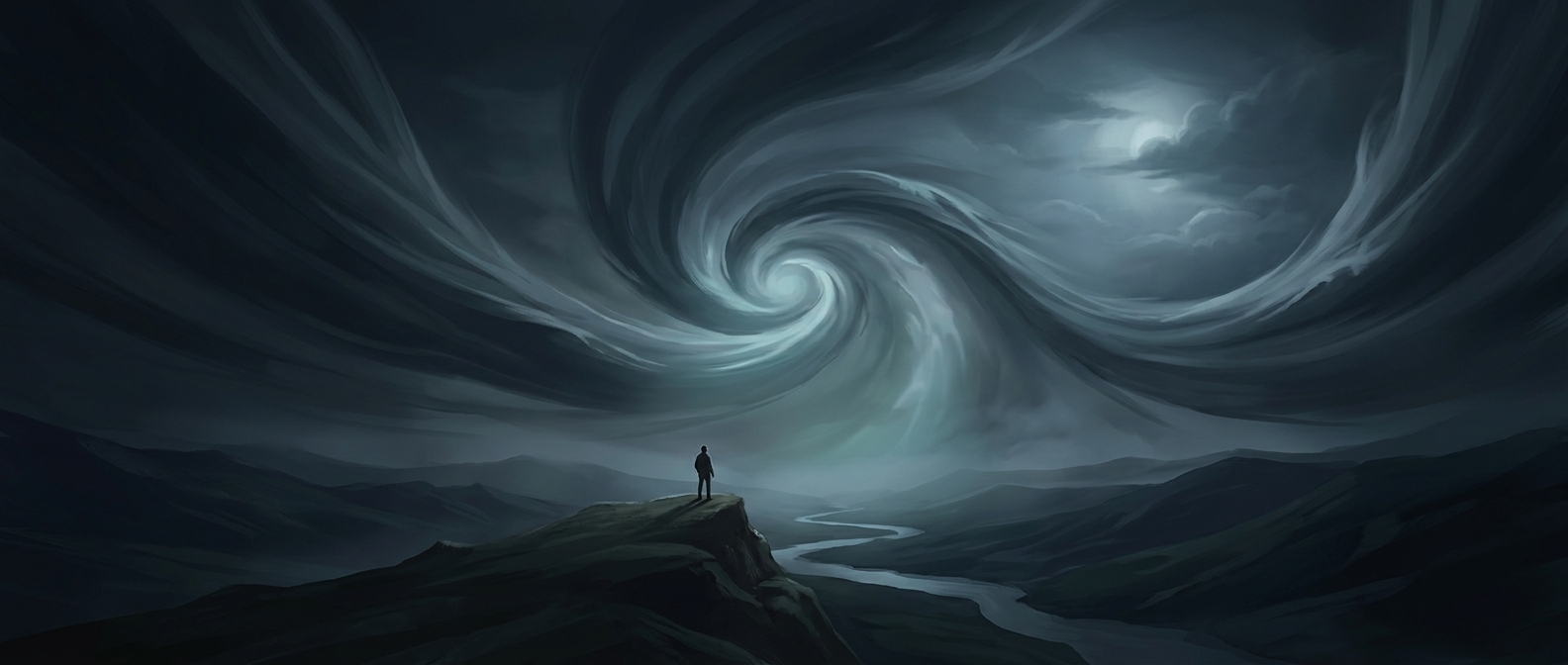
The effect does not start a storm or pull air inward by itself. It changes the direction of winds that are already moving, helping pressure-driven air flow around a large low-pressure center instead of straight into it. The resulting circulation turns counterclockwise around lows in the Northern Hemisphere and clockwise around lows in the Southern Hemisphere; high-pressure systems rotate the opposite way.
Why size and time matter
The sideways nudge is subtle over a short distance, but it accumulates as air travels across hundreds or thousands of kilometers. A storm can therefore develop an organized circulation even though the Coriolis effect is weak near its center. Very close to the equator, the effect becomes too small to organize a cyclone effectively, one reason tropical cyclones rarely form there.
A sink or toilet offers no comparable planetary-scale journey. Water may swirl as it drains, but the direction is usually set by the basin’s shape, the drain, and how the water was moving beforehand—not by Earth’s rotation. The contrast is a matter of scale: the same tiny deflection that is negligible in a bowl can help steer a storm spanning a continent.