Why the swing seems to turn
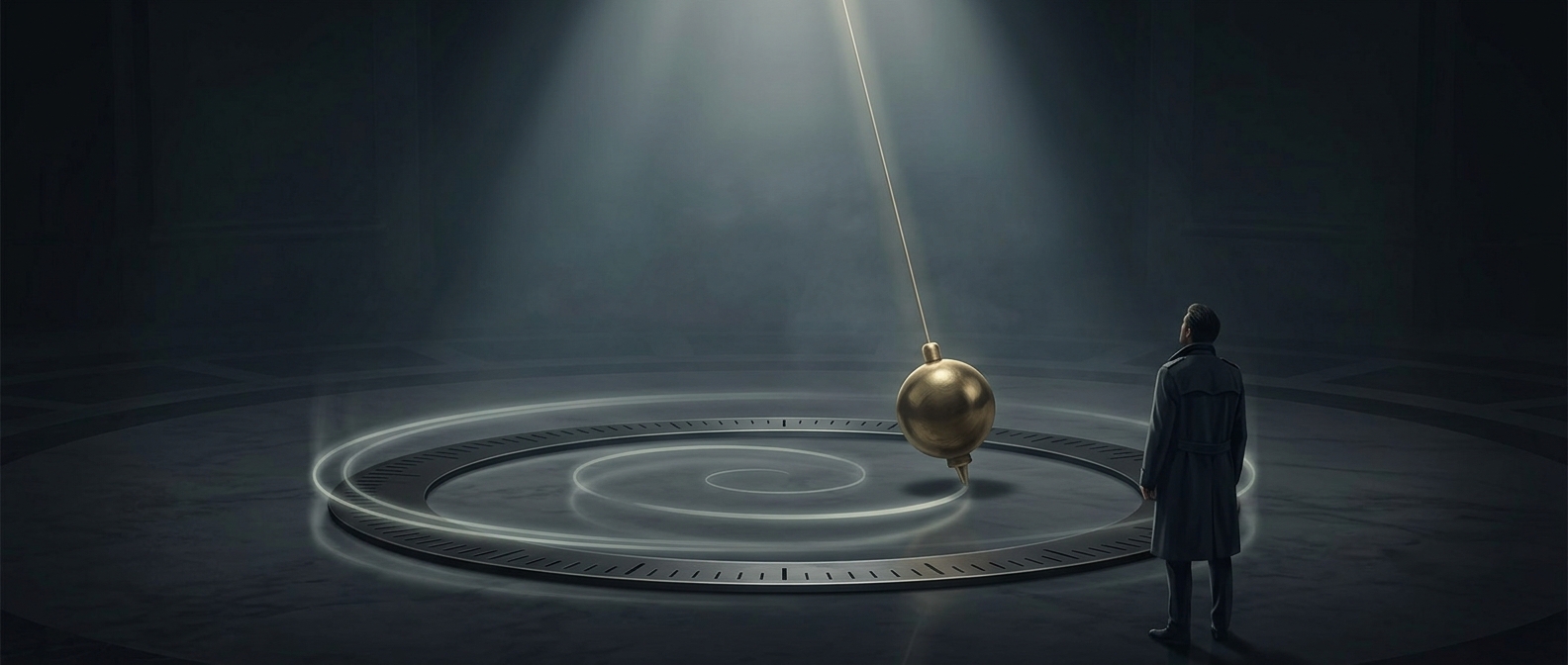
A pendulum swings back and forth in a plane: if you start it moving north–south, it continues along that line. The ground beneath it, however, is attached to a rotating planet. As Earth turns, the room and floor slowly shift their orientation relative to the pendulum’s swing, making the path appear to rotate when viewed from inside the room.
The effect is called precession: a gradual change in the direction of the swing’s plane relative to the ground. The pendulum is not perfectly isolated, but with a long, heavy bob and a careful setup, its tendency to keep its direction is strong enough to make Earth’s rotation visible.
Latitude sets the pace
The apparent turning depends on where the pendulum hangs. At the North or South Pole, the floor rotates beneath the swing at the full rate of Earth’s rotation, so the swing’s direction completes a turn relative to the ground in about a day. At the equator, Earth’s rotation carries the pendulum around without producing this apparent turning. Between those extremes, the rate increases with latitude: the closer the pendulum is to a pole, the faster its path appears to rotate.
The direction differs between the Northern and Southern Hemispheres. That reversal is a clue that the effect comes from Earth’s rotation, rather than from some fixed twist in the pendulum or its supports.
A local swing, a planetary clock
A pendulum’s back-and-forth motion is easy to see; the change in its swing plane is slow, so it becomes clearer over time. That slowness is part of the demonstration’s power: a simple object in a room tracks the motion of the planet beneath it. The same pendulum that marks seconds can, given enough time, show that the floor is moving even when everything nearby seems still.