Why rubbing can join solid metal
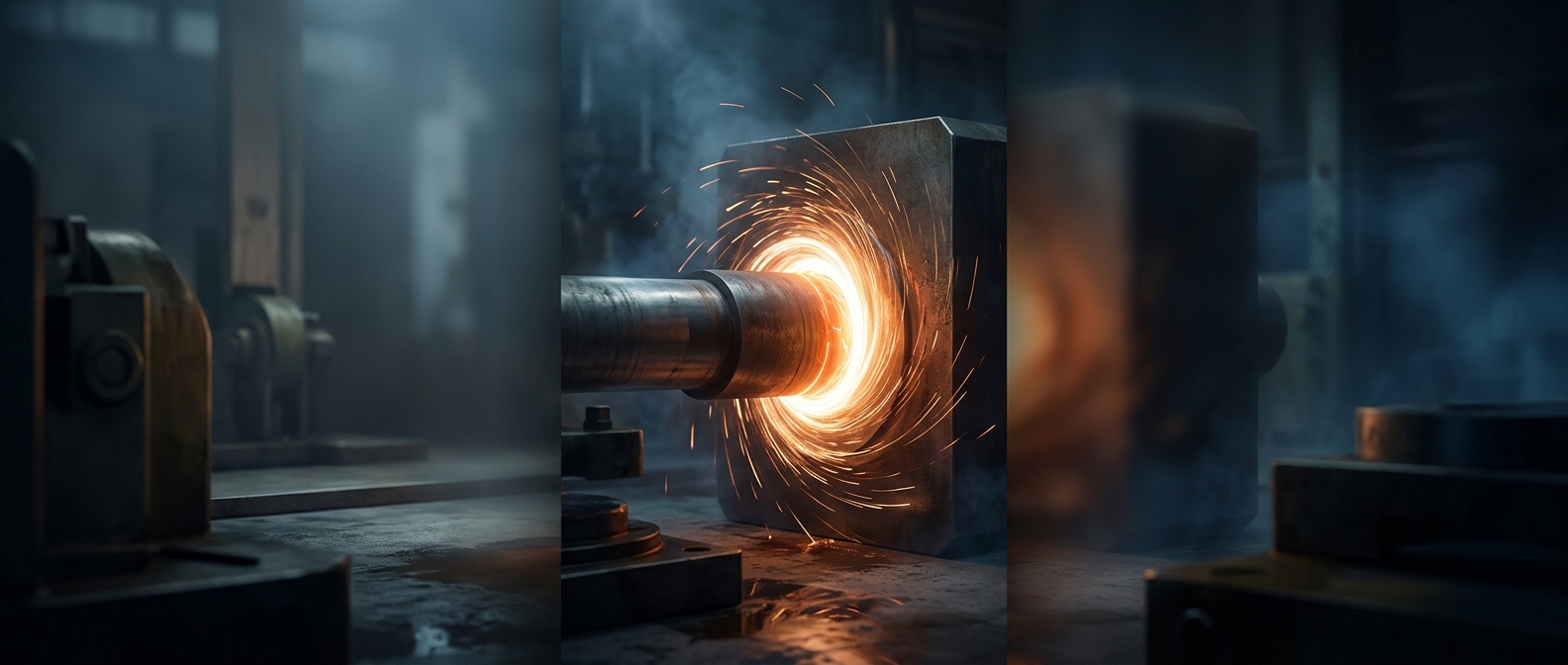
Friction welding turns motion into heat right at the boundary between two parts. In a common version, one piece spins against another while the machine presses them together. The rubbing concentrates energy in a thin layer, so the metal near the interface heats and softens even while most of each piece stays cooler and solid.
That localized heating matters: the process can form a strong joint without creating a pool of liquid metal. It also avoids relying on a torch to heat the whole area from outside.
Pressure makes the bond
As the surfaces soften, continued force squeezes material outward from the joint. This expelled rim, called flash, carries away surface contaminants and oxides—thin films that can keep clean metal surfaces from bonding. The pressure brings freshly exposed metal into intimate contact, allowing atoms on either side to form metallic bonds.
The machine then stops the motion and maintains pressure while the joint cools. The result is a solid-state weld: a weld made without melting the parts at their meeting surface. The exact balance of speed, force, and heating depends on the metals and the shape of the components.
The practical tradeoff
Because heat is concentrated at the interface, friction welding can join parts quickly and limit distortion elsewhere. But it needs equipment capable of controlling motion and force, and the parts must be arranged so they can be pressed together—often by spinning one of them. That makes the method useful for compatible components with suitable shapes, rather than a universal replacement for torch welding.
Its striking feature is that the visible rim of squeezed-out metal is evidence of the process at work: pressure has pushed the original surface layer aside to make room for the bond.