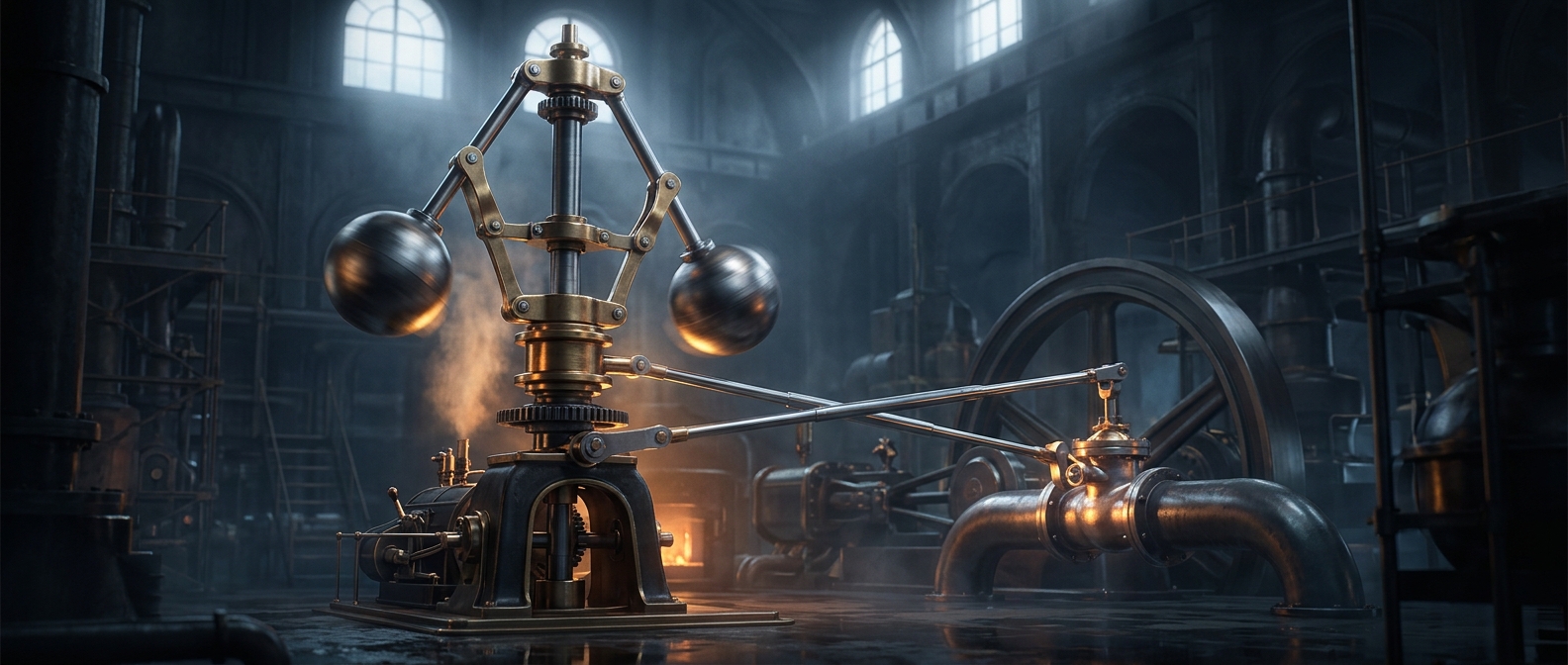
How a governor turns rotation into control
A centrifugal governor is a mechanical speed regulator. Its weights do not measure speed with a clock or electronic sensor; instead, their outward pull grows as the mechanism spins faster. Link the weights to a sliding collar and a lever, and that movement can operate a valve.
The engine’s motion therefore supplies both the signal and the force for correction. At higher speed, the weights move outward, the linkage nudges the valve toward less fuel or working fluid, and the engine loses some of the input driving it. As speed falls, the weights move inward and the valve opens farther. The response opposes the change that triggered it: that is negative feedback.
Why the mechanism settles instead of simply switching
The weights do not usually snap between “fast” and “slow.” Their position changes continuously, while springs or gravity pull against their outward motion. The governor balances those forces at a position that depends on rotational speed. The linkage and valve then settle around an opening that supplies enough power for the engine’s current load.
If a machine suddenly has to do more work, its speed tends to drop. The weights move inward, opening the valve and allowing more power in. Once the engine recovers, the weights move outward again. This automatic adjustment helps keep speed near a chosen operating range without a person constantly tending the controls.
A feedback loop made visible
The governor’s practical achievement is not perfect, unchanging speed: real engines take time to respond, and their speed can rise or fall before the mechanism catches up. It is a direct, self-powered way to limit those swings. You can watch the control loop happen in metal: faster rotation moves the weights, the linkage changes the input, and the altered input changes rotation in turn.