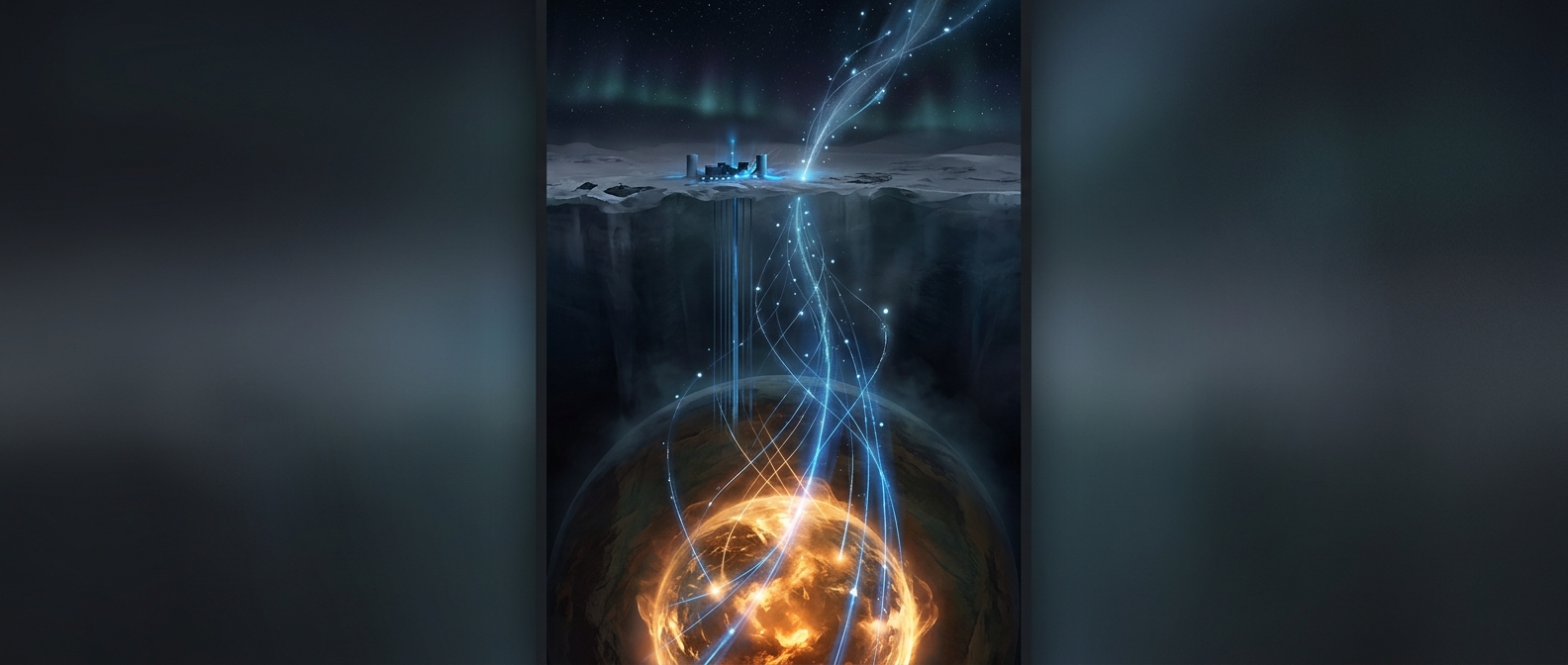
How IceCube turns neutrino traffic into a map of Earth
Neutrinos are tiny particles that rarely interact with matter. Most pass through Earth without changing course, but a small fraction collide with atoms along the way. The chance of a collision rises with the amount of material a neutrino crosses—and, especially for the most energetic neutrinos, with how energetic it is.
IceCube detects the faint flashes produced when a neutrino does interact. Its sensors are embedded deep in Antarctic ice, where they record blue light made by charged particles created in the collision. The pattern and timing of that light help researchers estimate where a neutrino came from and how much energy it carried. IceCube does not image the core directly; it samples the particle traffic passing through the planet.
From a shortage of particles to hidden density
Researchers compare how many neutrinos arrive from different directions with how many they would expect if Earth offered less material to cross. A direction that cuts through the core has a longer route through dense rock and metal than one that passes through the outer layers. More material means more opportunities for neutrinos to be absorbed or scattered out of the detectable path, leaving a small deficit in the arriving traffic.
That deficit is subtle, so the analysis relies on many detections and on sorting them by direction and energy. The energy information matters because neutrinos of different energies have different probabilities of interacting with matter. Comparing those patterns lets scientists test how Earth’s internal density is distributed, rather than treating the planet as a uniform ball.
A shadow, not a photograph
The method is a form of particle tomography: inferring what lies inside an object by measuring particles that cross it. Its resolution is limited by the number of detected neutrinos and by how precisely their paths and energies can be estimated. Even so, it offers a way to probe deep regions that no drill could reach. The core’s signature is not a visible outline, but a slight thinning in the stream of particles arriving from the far side of Earth.