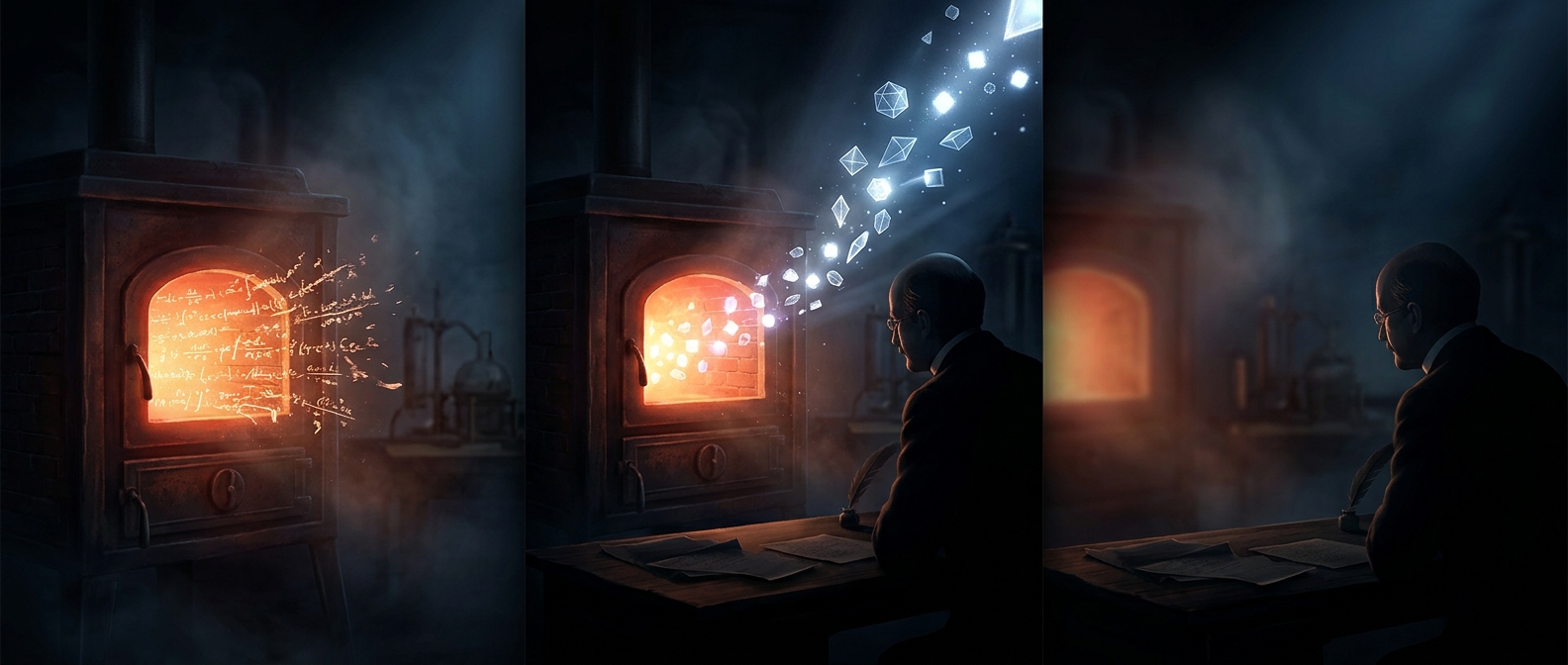
The spectrum that classical physics could not explain
A heated object does not glow with equal intensity at every color. Its light follows a characteristic curve: as it gets hotter, the balance of emitted wavelengths shifts. Physicists could measure this pattern, but the standard theory of the time could not reproduce it across the full spectrum.
The trouble became stark when scientists modeled radiation inside a closed, heated cavity. Classical physics implied that each possible vibration of the electromagnetic field should receive energy. At very high frequencies, the number of possible vibrations grows so rapidly that the model predicts an unbounded amount of energy—a result that plainly does not match observation. The mismatch became known as the ultraviolet catastrophe.
Why energy packets changed the calculation
Planck found a way to make the mathematics fit the measured spectrum by counting energy in discrete units, each proportional to the vibration’s frequency. In plain terms, a high-frequency vibration could exchange energy only in larger steps than a low-frequency one. That restriction prevents the model from assigning unlimited energy to ever-higher frequencies.
The key move was not simply to add a new kind of light to the equations. It changed what the equations allowed energy to do: instead of varying smoothly by any amount, energy exchange came in steps. Planck first used this idea as part of a calculation; the deeper claim that nature itself is quantized took further work by other physicists.
That distinction matters. A mathematical device for matching a glowing cavity’s spectrum became a clue that the smoothness assumed by classical physics had limits. The curve of light from a hot object had exposed a much bigger problem—and supplied the first foothold for quantum theory.