Momentum Sets a Boundary, Not a Bounce
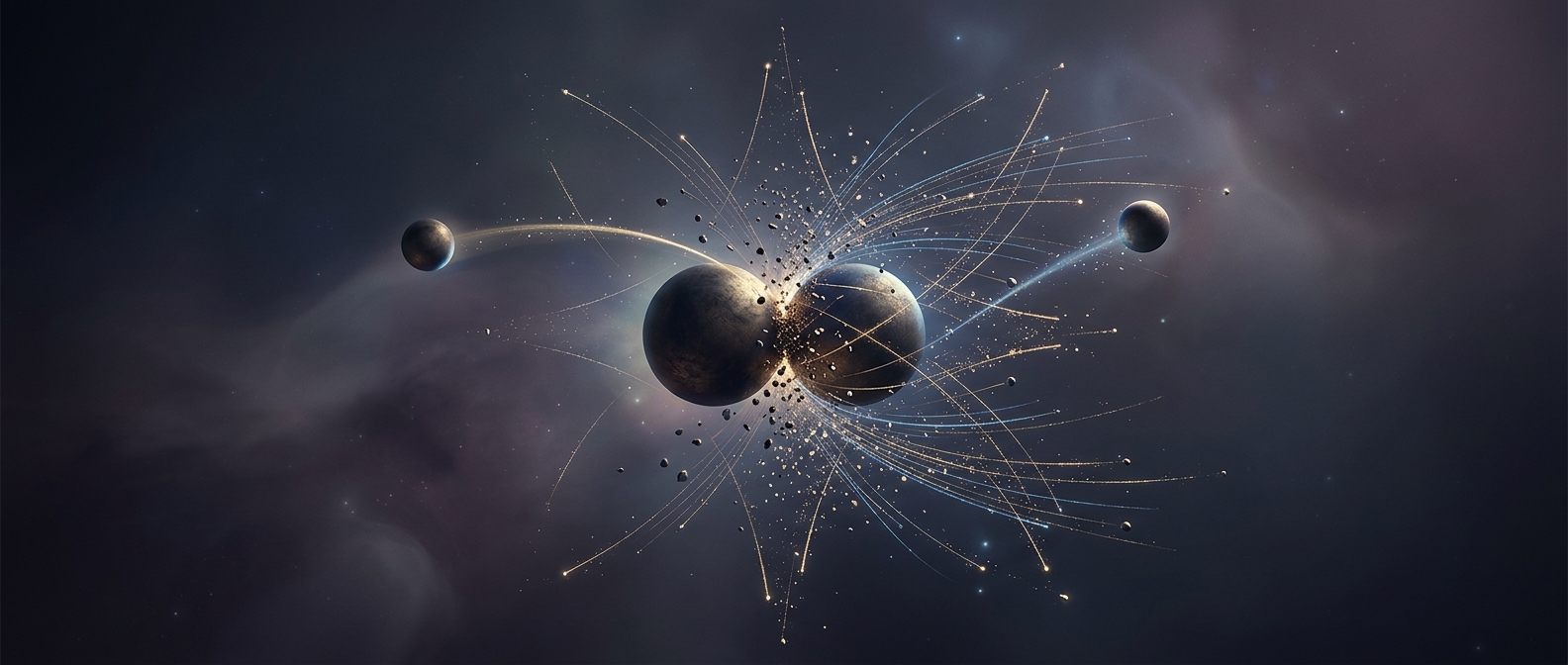
When objects collide, momentum—the amount of motion carried by an object, determined by its mass and velocity—must balance before and after the impact, provided outside forces are negligible. That rule sharply limits the possible outcomes. But it does not, by itself, say which allowed outcome will occur.
Imagine two carts rolling toward each other. Their combined momentum before impact must match their combined momentum afterward. Yet many different pairs of final speeds could satisfy that same balance. Momentum is a conservation rule, not a complete description of the collision.
Where the Missing Motion Goes
The second key question is how much of the objects’ organized motion survives the impact. In a perfectly elastic collision, kinetic energy—the energy of motion—is conserved as well as momentum. In a less elastic collision, some kinetic energy becomes other forms: objects may bend or dent, warm up, vibrate, or produce sound. Momentum has not vanished; the energy has changed form.
A useful measure is the coefficient of restitution, which describes how strongly the objects separate relative to how quickly they approached. A value near one indicates a springy rebound; a value near zero indicates little rebound along the line of impact. Real collisions can also involve rotation, sideways motion, and deformation, so this number does not capture every detail.
Why Prediction Needs More Than One Rule
To predict a particular bounce, you need the objects’ starting motion and enough information about their interaction—such as their masses and how much they rebound. Momentum conservation supplies a strict check on the result; the collision’s material response helps select among the possibilities it permits.
That distinction matters in everything from billiard balls to vehicle crashes: the same momentum balance can accompany a sharp rebound or a damaging, muffled impact. The bookkeeping rule stays fixed, while the collision determines how motion is redistributed or transformed.