The island’s stone roads preserve a puzzle
At Rano Raraku, the volcanic quarry where most moai were carved, unfinished figures still lie in the slopes. Others stand far away on ahu, the stone platforms that served as ceremonial sites. Between quarry and platform, the challenge was not simply lifting a statue: it was keeping a tall, heavy figure stable over uneven ground.
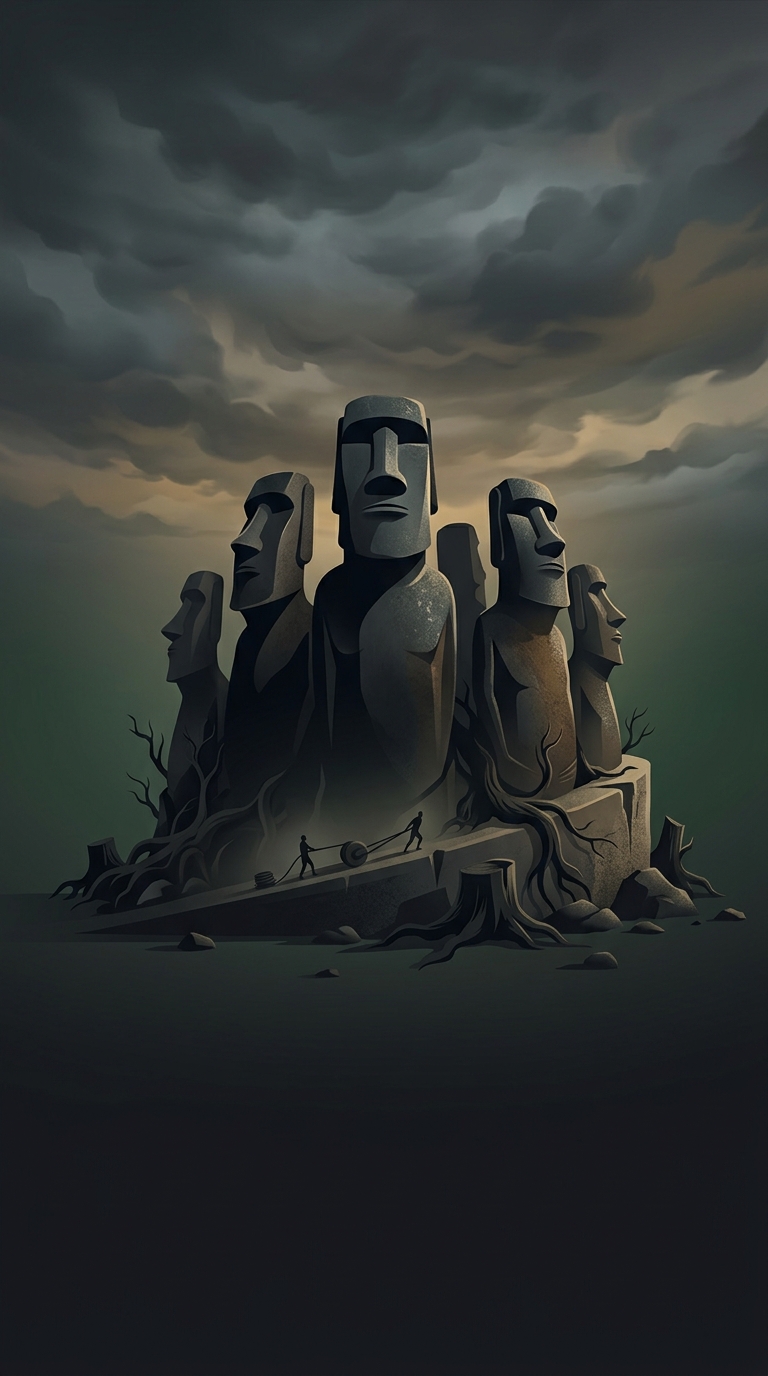
The Rapa Nui people shaped the statues with hard stone tools. But how they moved them remains unsettled. Archaeologists have considered methods involving sledges or rollers, as well as a more surprising possibility: transporting some moai upright.
Could the statues have “walked”?
Rapa Nui oral tradition describes the moai as walking to their destinations. In one proposed mechanism, teams using ropes would pull an upright statue alternately from side to side, rocking it forward in small steps. Experiments with replicas have shown that this motion can work under controlled conditions; the idea also helps explain why some statues have shapes suited to rocking.
That does not prove every moai traveled this way. Statues vary in size and shape, and moving a replica on a prepared route is not the same as reconstructing every journey across the island. Different methods may have been used, or techniques may have changed over time. The island’s roads and the statues themselves offer clues, but not a complete account.
What the journey may have cost
Moving the figures required organization, labor, and a route from quarry to community. The scale of that effort has fed a larger debate about Rapa Nui’s past: whether tree cutting for transport and other uses contributed to widespread deforestation and ecological change. The exact causes and timing remain contested, so the moai are not proof of a single collapse story.
On the ground, the puzzle is still visible: a quarry full of unfinished figures, platforms scattered across the coast, and a landscape in between that records the distance the statues had to travel.