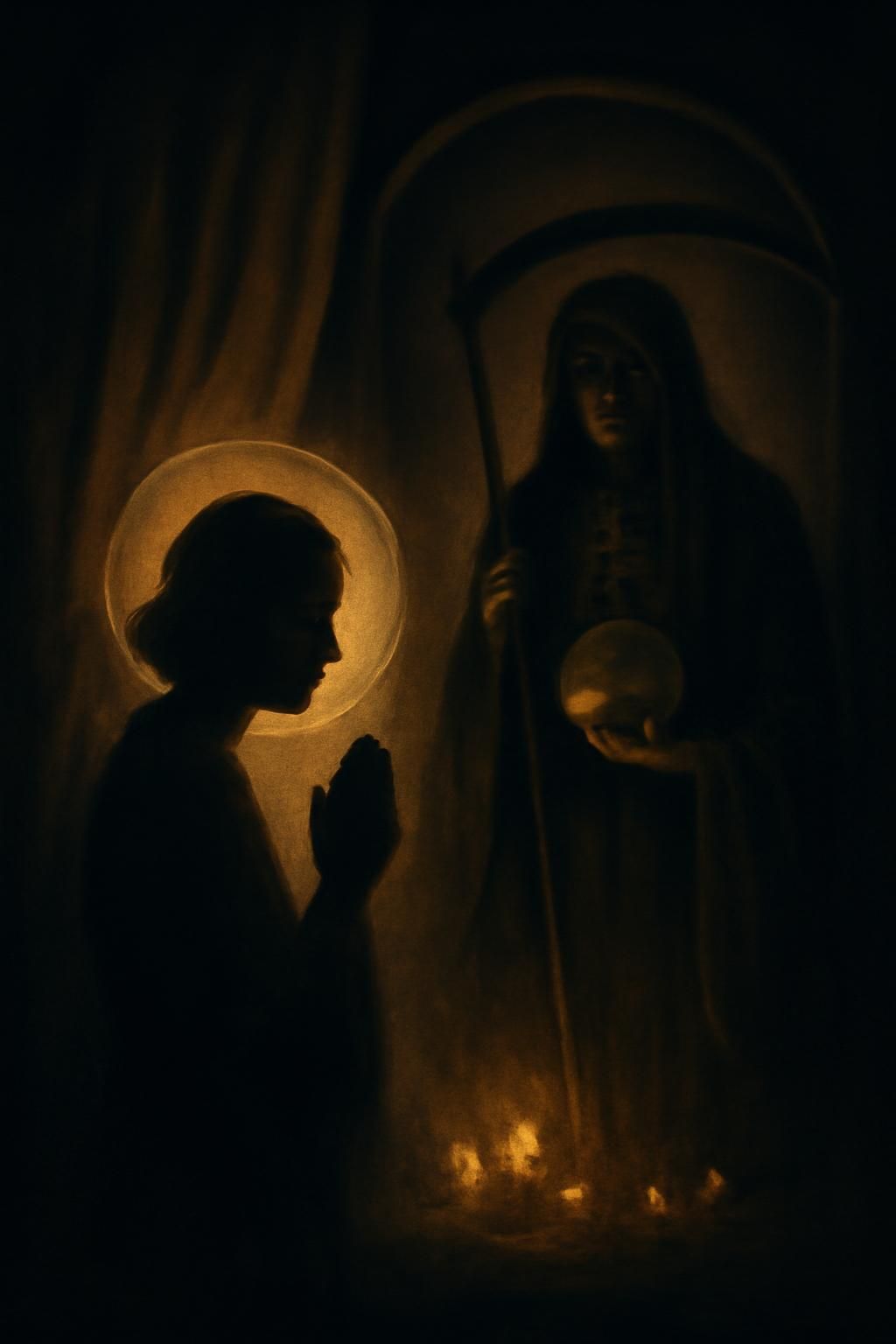
A folk saint outside the church calendar
The figure is usually Santa Muerte, Spanish for “Holy Death.” She is a popular folk-saint figure, especially associated with Mexico, but she has not been formally recognized as a saint by the Catholic Church. Devotees may still speak of her in the familiar language of Catholic devotion: they pray, make promises, and ask for help.
Her skeletal form gives the relationship its central image. Death is not imagined as a distant abstraction but as a power that reaches everyone, regardless of wealth or status. For followers, Santa Muerte can therefore represent protection and practical help in an uncertain world—not simply a fascination with dying.
What the offerings communicate
Candles and everyday gifts are part of an exchange of attention: devotees make an offering while asking for protection, health, money, love, or help with a particular danger. The meaning of an item can vary by person and local practice; it is not a universal code in which every color or object has one fixed interpretation. A small household shrine makes the devotion part of daily life, much like a place to pause, pray, and remember a request.
Keeping the figure out of sight can also reflect the tension around the practice. Some people worship privately because relatives, neighbors, or religious authorities disapprove. That privacy does not make the devotion less meaningful to its practitioners; it shows how a domestic ritual can sit alongside, or outside, a family’s public religious identity.