Turning a Paper Maze Into Field Rows
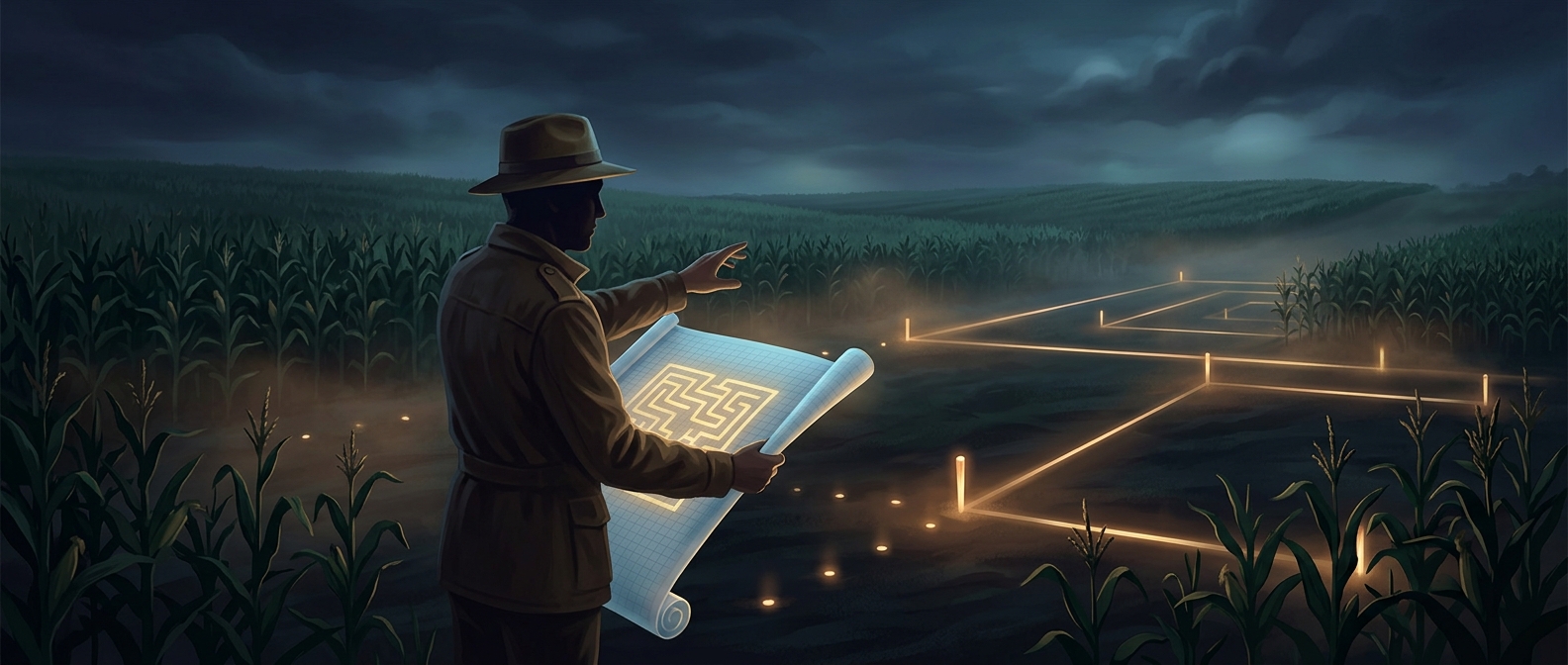
A maze on graph paper is only useful if its lines can be found again in a much larger field. Each square provides a small unit of distance: a drawn path can be translated into a certain number of planting rows and a certain length along them. That turns an intricate picture into a practical layout rather than a design someone must sketch freehand across acres of crops.
The field’s rows supply a built-in guide. A farmer can use their regular spacing and direction to keep long stretches straight, while measured reference points help locate turns and junctions. The key is consistency: if the drawing’s scale slips as it is transferred, passages may narrow, widen, or fail to meet where intended.
The Crop Becomes the Maze’s Wall
At first, the planted field is a solid mass. The design emerges by clearing chosen strips, exposing the ground where visitors will walk and leaving the standing corn to form the boundaries. Because the plants are still relatively short when this work is done, the layout can be checked and corrected before the stalks become a tall screen.
That timing matters. A maze needs paths broad enough to walk and walls dense enough to obscure the next turn. As the corn grows, those walls gain height, making a route that was easy to inspect from above feel confusing at ground level. Dead ends and misleading branches are not separate structures; they are simply places where the cleared route stops or turns away from the destination.
The result is a design with two scales: a carefully measured pattern on paper and a human-sized network among living plants. The most important test is not whether the drawing looks clever, but whether a visitor standing inside the rows can see only the next decision.