Before Computers Were Machines, They Were Workers
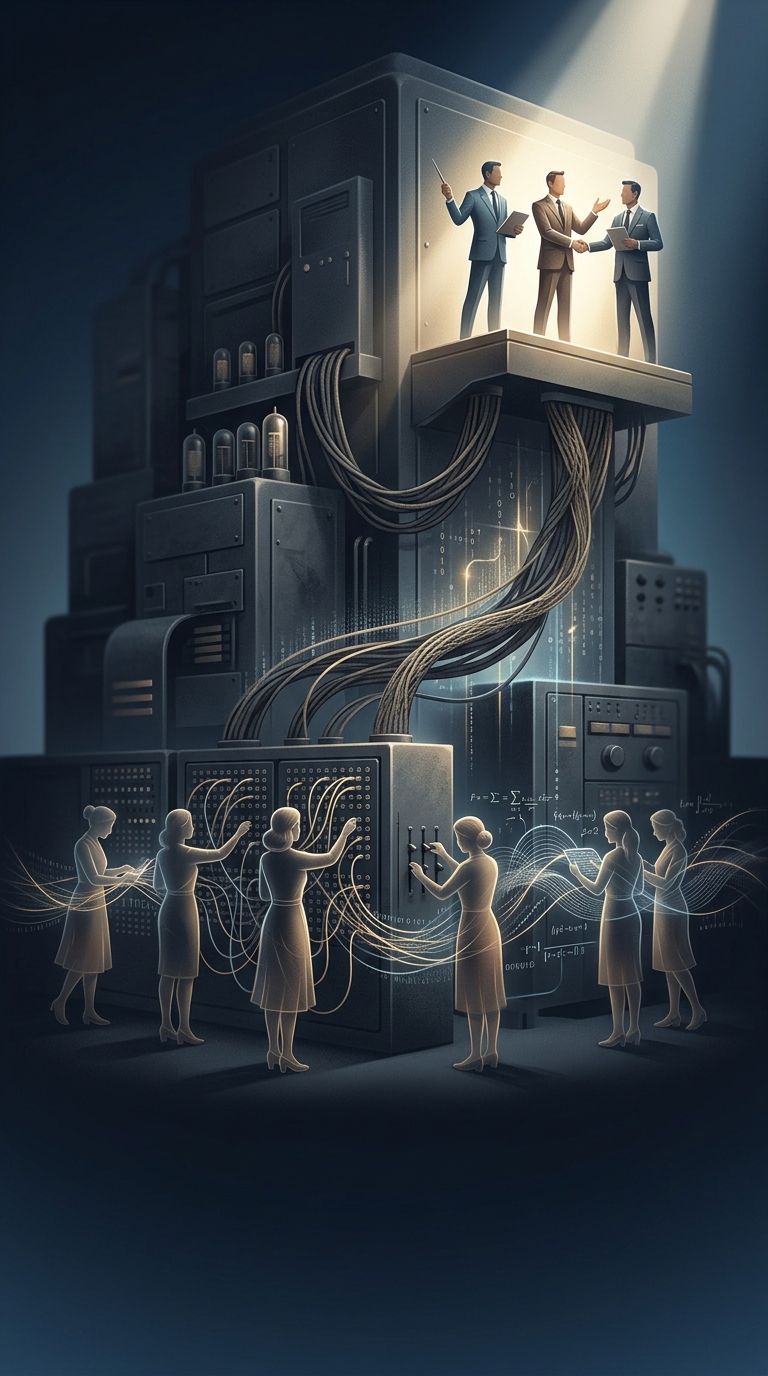
For much of the early twentieth century, a “computer” was a person whose job was to calculate. Teams of these workers turned mathematical formulas into usable numbers, often working through long sequences of arithmetic by hand or with desk calculators. The title described the task, much as “calculator” might describe a person who calculates—not a device sitting on a desk.
Women did much of this work. Employers often treated calculation as routine clerical labor, even when it required strong mathematical skill. That made women a major part of the workforce supporting scientific research and engineering, while senior technical roles were more often held by men.
Turning a Formula Into a Firing Table
A ballistic trajectory is the path an object follows through the air. Predicting one meant accounting for factors such as an object’s speed, direction, and the force of gravity. Military planners needed calculations that could help them estimate where a projectile would land, but a formula alone was not enough: its results had to be worked out across many possible conditions.
A computing team could divide that labor. One person might calculate a portion of the problem, another check the arithmetic, and others combine the results into tables that people could consult. A small mistake could carry through later steps, so checking was part of the process, not an optional polish.
What Changed When Electronic Computers Arrived
Electronic machines could perform arithmetic much faster, but they did not instantly make human expertise unnecessary. People still had to prepare problems in a form a machine could process, check whether its output made sense, and interpret the results. As machines took over more calculation, the word computer shifted from the person doing the work to the device doing it.
That change can make the older meaning easy to miss. Yet behind early calculations for science and military engineering were workers whose job title named a human skill—and whose careful arithmetic helped turn abstract equations into practical tables and decisions.