The hole grows by changing what counts as a target
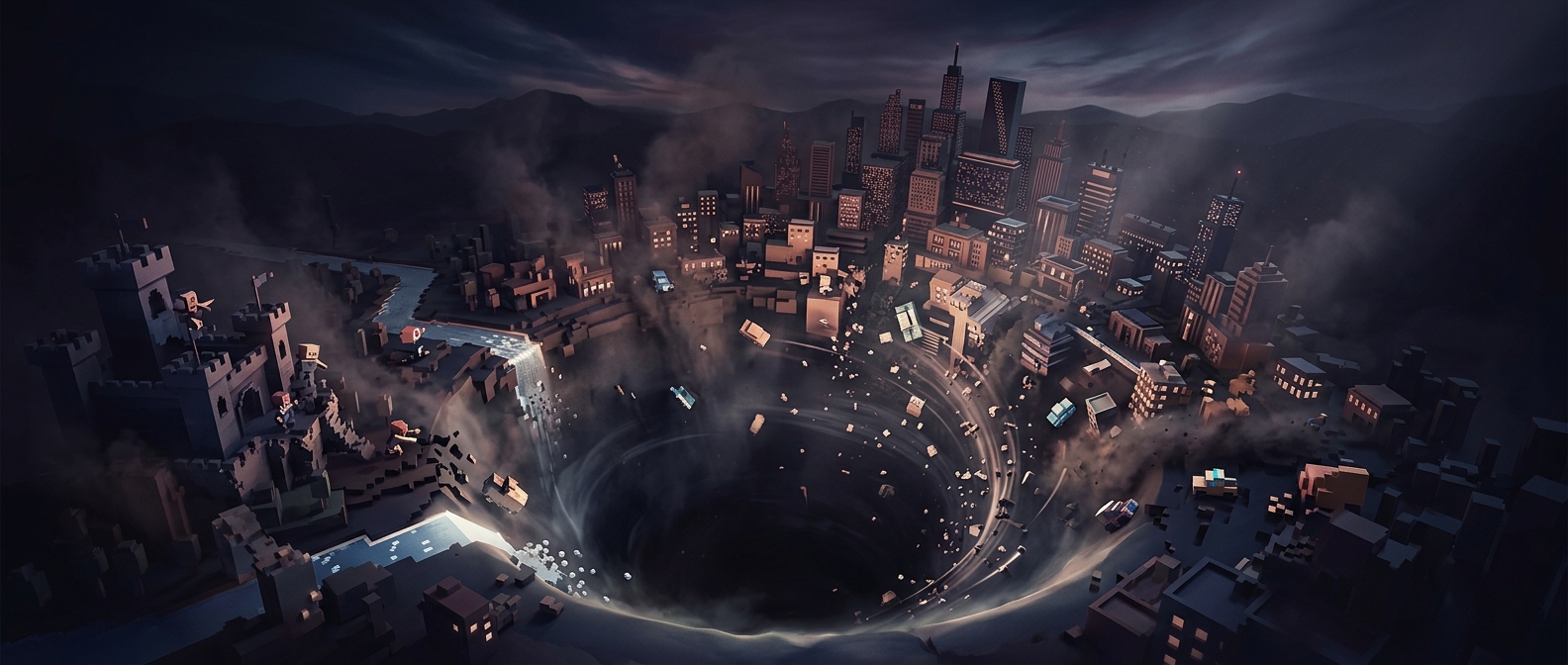
At first, the sinkhole in Donut County is too small to swallow much. You steer it beneath objects that fit; each one drops in, making the opening larger. That simple rule turns the landscape into a sequence of thresholds: a small object helps the hole reach the size needed for something bigger, which then makes still larger targets possible.
The player is not simply watching a disaster unfold. The puzzle is to decide where to move the hole and what to swallow next. A brick is useful not just because it disappears, but because it helps change the hole’s capacity. Familiar surroundings become a kind of inventory, with each object a step toward the next.
Escalation makes the joke work
The scale shift supplies the game’s central comic contrast. A hole that begins by consuming ordinary clutter eventually takes cars and buildings—and, ultimately, the raccoon community. The absurdity comes from applying one consistent rule to increasingly unreasonable targets: the hole keeps growing, so the world’s definition of “too big” keeps moving.
That steady escalation also gives the destruction a playful, deliberate feel rather than the randomness of a natural sinkhole. Each swallowed object advances both the puzzle and the spectacle. By the time a whole town can vanish, the player has already learned how a tiny opening becomes an unstoppable one.