How a Draconic Chart Is Recast
A draconic chart begins with the same birth data as a standard natal chart, but changes the zodiac’s starting point. The astrologer shifts every planet and chart angle by the amount needed to place the North Node of the Moon at 0° Aries. The North Node is the point where the Moon’s apparent path crosses the Sun’s path moving northward; it is a calculated point, not a planet.
Because all the placements shift together, their relationships to one another—such as the angle between two planets—stay the same. What changes is the sign assigned to each placement. A planet that appears in one sign in a standard chart may fall in another in the draconic version.
Two Charts, Two Interpretive Lenses
Astrologers who use this system read the standard chart as describing a person’s familiar character and life patterns, while treating the draconic chart as a symbolic account of deeper motives or spiritual direction. The second chart is not a separate observation of a soul; it is a reinterpretation of the same planetary arrangement after the zodiac has been rotated.
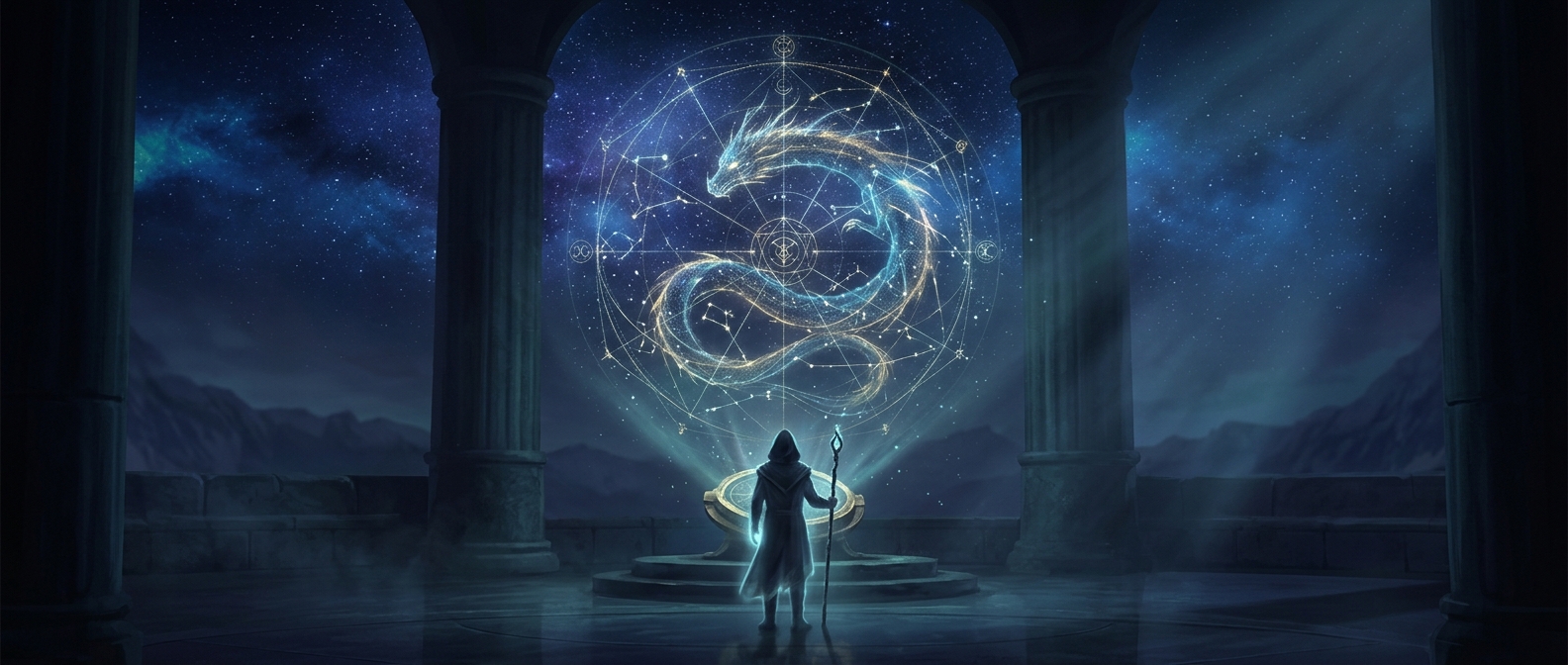
“Draconic” refers to the dragon imagery historically associated in astrology with the Moon’s nodes: the North Node is sometimes called the Dragon’s Head and the South Node the Dragon’s Tail. In practice, the comparison is the point. An astrologer might look at a planet’s sign in both charts and ask what changes when its outward expression is considered alongside the system’s proposed inner intention.
The result is a distinct reading, not a second birth chart created by a different birth time or place. Its meaning depends on accepting astrology’s symbolic framework, rather than on a scientifically demonstrated measurement of hidden intentions.