Why a Mirror Can Look Like an Opening
A camera records light, not distance. To estimate how far away something is, a vision system looks for clues in the image: nearby objects may appear larger, edges may converge with distance, and surface patterns may grow smaller or blur. Some systems also compare images from two cameras or track how a scene changes as the camera moves.
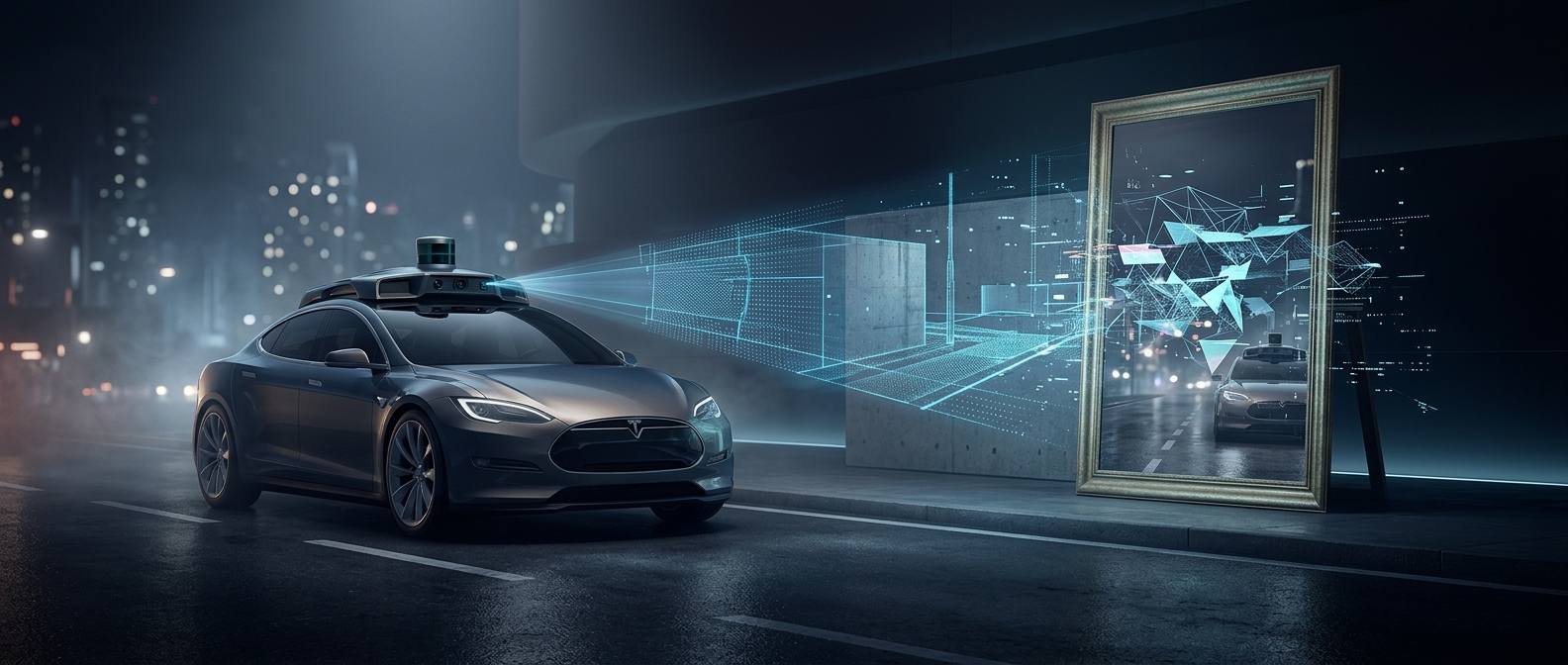
A mirror scrambles those clues. The light arriving from a point in the reflection has bounced off the glass, so the camera sees a convincing view of objects that are not physically located behind the mirror. A patterned floor reflected in the glass can look like a real floor receding into a second room. The image may contain familiar depth cues, but they describe the reflected scene—not the space behind the mirror.
When the Software Trusts the Wrong Clues
Many vision systems combine visual cues rather than measuring depth directly. If the reflected image resembles a familiar hallway or doorway, software may classify it as open space. A depth estimator can likewise assign distances to the apparent surfaces, even though those surfaces are virtual images produced by the reflection.
The mismatch matters when a machine must act on its interpretation. A robot navigating indoors, for example, could treat a reflected corridor as a route and misjudge where a wall or opening actually is. The precise error depends on the camera, the algorithm, and the mirror’s position; not every system will make the same mistake.
Recognizing Reflections as a Special Case
A mirror is difficult because it does not behave like an ordinary matte surface: its appearance changes with the scene and viewpoint, and the visible pattern belongs to whatever it reflects. Systems can reduce confusion by learning to identify reflective surfaces or by checking image-based guesses against other evidence, such as sensor measurements or known room geometry.
The key distinction is simple: a reflection can depict real depth without occupying that depth. For a machine planning where to move, a convincing view of another room is still just light arriving from a mirror.